


No Credit Check Loans in Georgia: What the Law Actually Allows
A text lands on your phone at 9 p.m.: "Approved in minutes, no credit check, Georgia residents welcome." Your credit score has taken hits you'd rather not think about, and the offer reads like the fastest way out of a tight week. Here's what that ad leaves out: searching for no credit check loans in Georgia puts you in one of the strictest legal environments in the country for small-dollar lending, and a lot of what gets marketed to Georgia residents is flatly illegal to offer in the first place.
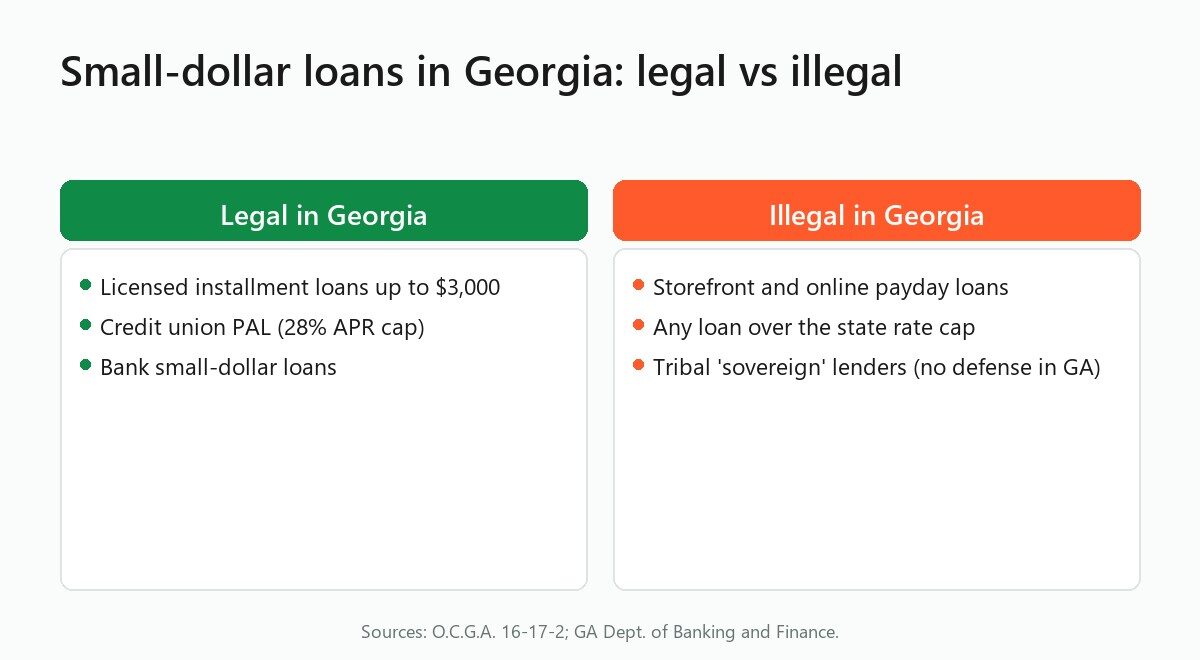
Georgia banned payday lending outright. The Georgia Department of Banking and Finance says so directly, and so does the Attorney General's Consumer Protection Division, in almost identical language. That single fact is why most national "no credit check loan" roundups fail Georgia readers. They're written for a country where some states cap payday fees and others ban them, and they rarely stop to ask which kind of state you're actually in.
People searching this phrase are usually not browsing out of curiosity. A bill or a repair is due before the next paycheck lands, a bank or a mainstream lender already said no, and an aggressive "guaranteed approval" ad showed up by text or on social media at the worst possible moment. The question that actually matters is whether the company sending that text can legally collect a dime from you if you say yes.
Is Payday Lending Actually Illegal in Georgia?
Yes. Georgia's payday lending ban is codified at O.C.G.A. § 16-17-2, part of the state's Payday Lending Act. The Georgia Attorney General's Consumer Protection Division confirms the same rule in consumer-facing language on its own site.
The ban sits inside a larger framework. Georgia's Payday Lending Act begins at O.C.G.A. § 16-17-1, and the Consumer Protection Division also points to the state's general usury law, O.C.G.A. § 7-4-1 et seq., when it lays out where small-dollar lending is and isn't allowed.
The ban isn't limited to storefront check-cashing shops. The Consumer Protection Division describes the prohibition as covering "any business that involves the lending of amounts of $3,000 or less" outside Georgia's licensed lending framework. That detail is the one most national content skips. An app, a text-message lender, or a website marketing itself as a fast, no-credit-check option falls under that same ban unless it holds a Georgia installment lender license.
A payday loan that once operated out of a strip-mall storefront can now arrive as an app download or a landing page from an ad you tapped on your phone. The delivery method changed. The statute didn't. That scope point comes straight from the Attorney General's Consumer Protection Division: Georgia's Payday Lending Act doesn't carve out an exception for a lender that never opens a physical office in the state.
Georgia belongs to the states where payday loans are banned outright, rather than the states that merely cap fees and call it regulation. Georgia's Payday Lending Act doesn't leave that door open, and the Department of Banking and Finance treats unlicensed small-dollar lending to Georgia residents as a compliance problem it actively investigates.
It's tempting to assume a slick app or a well-funded national brand must have already cleared this hurdle. That assumption is exactly what out-of-state and offshore advertisers count on. A polished website, a five-star app store rating, and a fast approval screen say nothing about whether a company holds a Georgia license. The only thing that answers that question is the license itself, which is why the verification step later in this article matters more than how professional an offer looks.
What "No Credit Check" Actually Means
The phrase "no credit check" describes an underwriting decision. It has nothing to do with whether a loan is legal in Georgia, and it rarely means what a borrower assumes it means. In practice, a lender using that phrase typically skips a hard pull against your FICO-scored file at Equifax, Experian, or TransUnion. Somebody still looks at your history; they're just looking somewhere else.
Many of these lenders run a soft credit check and lean on alternative-data underwriting instead: deposit and payment account history from specialty reporting companies, or income and employment verification services. The Consumer Financial Protection Bureau maintains a list of these specialty consumer reporting companies, including deposit-account screeners like Certegy Payment Solutions and employment-verification services like The Work Number. If you've been told you have no credit score, this is worth knowing: there's an alternative credit file lenders actually check, even when your mainstream credit report is thin.
None of that changes the legal question. A lender can run zero traditional credit checks, five alternative-data checks, or anything in between, and the loan can still be illegal in Georgia if it's a small-dollar, short-term product offered outside the state's licensed framework. Underwriting method and legal authorization are two separate questions, and an ad that answers one doesn't answer the other.
There's a practical upside to understanding this distinction. A soft credit check, the kind most of these lenders run, doesn't show up on your credit report the way a hard pull does, and it doesn't ding your score the way applying for several store cards in one week would. That part of the "no credit check" pitch is usually accurate. It just isn't the part that decides whether the loan is legal to accept in the first place.
The One Legal Path: Georgia-Licensed Installment Loans
Georgia does provide one legal channel for a small-dollar loan of $3,000 or less: a loan made by a lender licensed under the Georgia Installment Loan Act, O.C.G.A. §§ 7-3-1 through 7-3-52. The Department of Banking and Finance issues and supervises these licenses, and a lender has to hold one before it can make this kind of loan to a Georgia resident.

Before you sign anything, verify the lender through NMLS Consumer Access, the same national licensing database the Department of Banking and Finance points consumers to for checking installment lender authorization. Search the company name. If it doesn't come up as licensed to do installment lending business in Georgia, you're not looking at a legal offer, whatever the landing page claims.
Licensed doesn't mean cheap. The Department's own consumer page is blunt about it: "Consumers should be aware that the maximum interest rates allowed under the law may be significantly higher than what is being offered in the market." That same page doesn't list what the maximum actually is, so comparing total cost against what you can actually repay falls on you, even once you've confirmed the license is real.
Once you've confirmed a lender is licensed, read the agreement itself before you sign anything, not just the approval screen. Look for the payment schedule, the number of payments, the total finance charge in dollars, and the license number the Department of Banking and Finance assigned that company. If any of those pieces are missing, vague, or buried behind a "final terms after approval" message, treat that as a reason to slow down rather than a normal part of the process.
How to Spot an Illegal Offer
A handful of patterns separate a licensed offer from an illegal one. Guaranteed approval regardless of income or history is a warning sign no legitimate underwriter would put in writing. Unsolicited contact by text or social media, pressure to wire funds or pay an upfront fee before you see any loan terms, and a company that doesn't show up on NMLS Consumer Access all point the same direction. None of these tactics require a Georgia address or a Georgia office; an offshore call center can text a Georgia phone number just as easily as a licensed lender down the street can.
One red flag deserves its own explanation: tribal immunity claims. Some online lenders argue that an affiliation with a Native American tribe puts their loans outside state law entirely, an arrangement consumer advocates often call rent-a-tribe lending. The full mechanics of how to spot a rent-a-tribe lender take a while to unpack, but Georgia's answer is short: the claim doesn't work here, according to the Attorney General's Consumer Protection Division.
The Georgia Attorney General's Consumer Protection Division states it directly: "Some lenders may claim to have tribal immunity from Georgia's payday lending law. This is not a defense to payday lending in this state."
The Division cites the case W. Sky Fin., LLC v. State of Ga. as its authority for that statement.
A tribal affiliation, real or claimed, doesn't move a lender's Georgia loans outside the state's payday-lending ban, no matter how the fine print describes the arrangement. The loan is still subject to the same prohibition as any other unlicensed small-dollar lender marketing to Georgia residents, and the borrower's obligations are decided under Georgia law rather than under a claimed tribal exemption.
There's a second piece of that same regulatory guidance that matters even more if you've already taken one of these loans out. Any loan made in violation of Georgia's payday-lending prohibition is automatically void, according to the Attorney General's Consumer Protection Division. An illegal lender has no legal right to collect principal, fees, or interest on a void loan, which changes the leverage in that collection call more than most borrowers realize.
That doesn't mean you should ignore the calls or stop responding altogether. It means the debt a collector is pressing you to repay may not be legally owed at all, and that's a fact worth having in hand before you agree to any payment plan. Ask the collector to identify the original lender's Georgia license number before you send another dollar.
If you think you've been offered, or already hold, an illegal loan, both Georgia regulators take complaints. The Department of Banking and Finance's consumer line is 770-986-1633, and it investigates unlicensed lending directly. The Attorney General's Consumer Protection Division handles consumer-facing complaints and enforcement under the same statutes.
Safer Alternatives Before You Borrow
If you need cash before your next paycheck and every offer you're seeing looks like the ones described above, there's a federally regulated option built for this exact situation: credit union Payday Alternative Loans capped at 28% APR. These loans are governed by a nationwide federal rule, 12 CFR 701.21, so a federal credit union in Georgia follows the same terms as one anywhere else in the country.
PAL loans come in two versions. PAL I runs from $200 to $1,000 over one to six months, and PAL II goes up to $2,000. The application fee is capped at $20 either way, and the 28% APR ceiling applies to the entire loan, not just an introductory period.
Run the math on a typical PAL I loan and the gap versus an unlicensed offer gets concrete fast. Borrow $500 over six months at the 28% APR ceiling and interest works out to roughly $42, plus the $20 application fee, for about $62 in total finance cost on top of what you borrowed. That's an estimate based on the published rate and fee caps, not a quote from any specific credit union, but it shows why a federally capped product is worth the membership hassle compared to an offer with no verifiable rate at all.
To get one, you need to be a member of a federal credit union. That membership step is worth completing before you accept an offer you can't independently verify. A federal credit union loan capped by federal rule sits in a completely different risk category than an unlicensed lender operating outside Georgia law.
Frequently Asked Questions
Yes, in almost every case. Georgia's Payday Lending Act, O.C.G.A. § 16-17-2, bans payday lending outright, and the Attorney General's Consumer Protection Division confirms the ban covers small-dollar loans of $3,000 or less regardless of how they're marketed. An exception exists only for lenders licensed under the Georgia Installment Loan Act.
Under Georgia law, a loan made in violation of the payday-lending ban is automatically void, meaning the lender has no legal right to collect principal, fees, or interest. Contact the Georgia Department of Banking and Finance at 770-986-1633 or the Attorney General's Consumer Protection Division before making further payments.
Search the lender's name on NMLS Consumer Access, the licensing database the Georgia Department of Banking and Finance directs consumers to use. If the company doesn't appear as licensed for installment lending business in Georgia, treat the offer as unauthorized and don't sign anything.
Yes. Payday Alternative Loans are a federal credit union product governed by a nationwide rule, 12 CFR 701.21, so Georgia members qualify on the same terms as members anywhere else. APR is capped at 28%, application fees at $20, and you'll need federal credit union membership first.