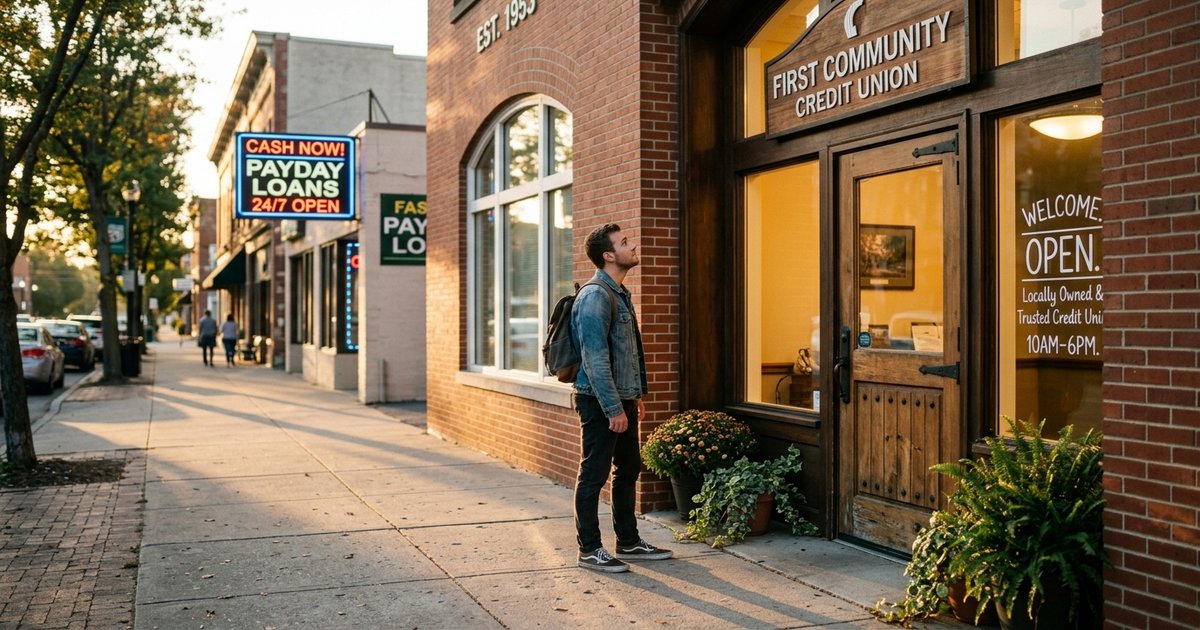
The cheapest legitimate small-dollar loan in the country is one most borrowers have never heard of, and almost nobody at the payday counter is going to mention it. It is called a Payday Alternative Loan, a PAL, and it comes from credit unions under federal rules written by the National Credit Union Administration. The rate is capped at 28 percent APR. The application fee is capped at $20. PAL I lets you borrow up to $1,000 and requires that you have been a credit union member for at least one month. PAL II goes up to $2,000 with no waiting period. The catch is supply, not price: only about 1 in 10 federal credit unions actually offer them, so finding one usually takes a few phone calls.
If you have ever paid 400 percent APR on a payday loan, the next sentence is going to sting. There is a federally regulated small-dollar loan capped at 28 percent interest and a $20 fee, designed specifically for borrowers like you, and almost nobody at the payday counter is going to mention it.
It is called a Payday Alternative Loan, or PAL. It comes from credit unions, not banks, not online lenders. And while only about 10 percent of federal credit unions actually offer them, the ones that do are often the cheapest legitimate small-dollar option you will find anywhere in the country.
I have walked plenty of borrowers through this product in person. The product is straightforward. The problem is finding a credit union that offers it and getting in the door. Both are solvable. Here is the playbook.
What a PAL Actually Is
The National Credit Union Administration (NCUA), the federal regulator for credit unions, created Payday Alternative Loans in 2010. The whole point was to give credit unions a way to compete with payday lenders on speed and accessibility, but without the fee structure that traps people in rollover cycles.
The rules sit in 12 CFR 701.21(c)(7). Two flavors exist: PAL I and PAL II. Both cap the rate at 28 percent APR. Both cap the application fee at $20, and that fee has to reflect the credit union's actual processing cost, not a profit center. Federal credit unions can make no more than three PALs to a single borrower in any rolling 6-month period and they cannot roll a PAL over.
That last sentence is the magic. The whole reason payday loans destroy people is the rollover. Cannot pay this Friday? Refinance it, pay another fee, push it to next Friday. PALs do not let the credit union do that to you.
PAL I vs. PAL II at a Glance
The two products look similar on the surface but differ in three places that matter to a borrower deciding which one to ask for.
PAL I
- Loan amount: $200 to $1,000.
- Term: 1 to 6 months.
- You must have been a credit union member for at least one month before applying.
- Maximum rate: 28 percent APR. Application fee capped at $20.
PAL II
- Loan amount: up to $2,000. No minimum.
- Term: 1 to 12 months.
- No minimum membership waiting period. You can join the credit union today and apply today.
- Maximum rate: 28 percent APR. Application fee capped at $20.
If you need money this week and you are not already a member of a credit union, PAL II is the one to ask for. If you have time to plan and you want a smaller, shorter loan with a slightly easier underwriting reputation, PAL I works.
Step One: Find a Credit Union That Actually Offers PALs
This is the part that trips people up. Most articles assume your local credit union offers PALs. Most do not.
According to BauerFinancial and NCUA call report data, more than 450 federal credit unions offered PALs as of the most recent reporting period, out of roughly 4,600 federally insured credit unions in the country. That is about one in ten. So you have to do a little legwork.
The fastest method:
- Go to the NCUA's credit union locator. This is the official consumer locator tool.
- Search by ZIP code. Pull up a list of credit unions within 25 miles.
- For each one, do not just walk in cold. Call the member services number and ask, in plain English: "Do you offer a Payday Alternative Loan, also called a PAL?"
- If the rep says yes, ask whether it is PAL I or PAL II, what the current rate is, and what the minimum membership waiting period is.
- If they say no, move to the next one on the list.
You may make five calls and find one credit union that offers it. That one call is worth a $300 fee on a payday loan you do not have to take.
"But I Cannot Even Join a Credit Union, Can I?"
This is the second misconception I had to break for borrowers every single week. People assume you need to work for the government, be in the military, or have a connected family member.
That has not been true for a long time. Most credit unions now operate under a community charter, which means anyone who lives, works, worships, or attends school in a defined geographic area can join. Others offer membership through a $5 to $25 donation to an affiliated association.
Specific examples (verify current eligibility, these change):
- Many community credit unions accept anyone who lives in a particular county or city.
- Some national-reach credit unions offer membership through donation-based associations.
- Some employer-based credit unions have expanded to "select employee groups," and the list of qualifying employers is much wider than you would expect.
When you call, ask: "What is your field of membership and what is the easiest way for me to qualify?" The rep will walk you through it. Most credit unions want new members. You are doing them a favor.
The 30-Day Wait Problem (And How PAL II Solves It)
Here is the gotcha with PAL I. You have to have been a credit union member for at least one month before applying. If you found the credit union today because you need $400 by Friday, PAL I is not your tool.
PAL II was created specifically to fix that problem. NCUA's December 2019 Final Rule on PAL II removed the membership waiting period. You can join today and apply for a PAL II today.
Now, "apply today" is not the same as "funded today." Credit unions still underwrite. Most credit unions will fund a PAL within 24 to 72 hours of approval. Some same-day funding happens but it is the exception, not the rule. If you literally need money in your account in the next four hours, a PAL is probably not going to make it.
The TILA APR Footnote (And Why It Is Not a Scam)
Here is a fact that confuses borrowers. If you take a $200 PAL I for one month at 28 percent interest and pay the $20 application fee, the Truth in Lending Act-disclosed APR on your loan agreement will be much higher than 28 percent. It can show something like 191 percent.
That is because TILA math treats the $20 fee as a finance charge and amortizes it across the one-month term. The actual cost to you is still $20 in fee plus about $4.67 in interest. Total cost: roughly $24.67 on a $200 loan you carry for a month. That same $200 at a payday lender would cost you $30 to $60 in fees for two weeks, and probably $60 to $120 if you rolled it.
I am pointing this out because I have seen borrowers see the TILA APR on the loan doc, panic, and walk away from a PAL. Do not do that. Read the dollar cost, not just the APR figure. The dollar cost is what is leaving your account. Our APR translation guide walks through this in more depth.
What to Do If No Credit Union Near You Offers PALs
Sometimes the answer is no across the board. You called five credit unions and none of them have PAL on the menu. Now what?
A few real options.
1. Ask the credit union about their regular signature loan. Many credit unions offer unsecured personal loans starting at $500 with rates in the 10 to 18 percent range for members in good standing. The credit pull is usually a soft pre-qualification first. If your score is in the 580 to 650 range, you may qualify for a signature loan even if you do not qualify for a PAL.
2. Look at a state-licensed installment loan. A short-term installment loan in the $500 to $5,000 range, properly licensed in your state, is built differently from a payday loan. It is amortized, the term is months not weeks, and the APR is disclosed up front. Quick5k connects borrowers with licensed lending partners in this range. We are not a lender ourselves. We do not set the rate or term. We connect the borrower with partners who do.
3. Talk to HR. A lot of employers run hardship grant programs or offer free, employer-sponsored earned wage access. Workers usually have no idea these exist because nobody at HR proactively advertises them. Our guide to employer help before borrowing covers exactly how to ask.
4. Avoid the title lender. If you are circling a title loan because the credit union said no and you need money this week, please read our title-loan position piece before you sign anything. Losing the car is worse than the loan amount suggests.
A Real Cost Example: $500 PAL II Over 6 Months
Let us run this honestly so you can compare it to whatever else is in front of you.
- Loan amount: $500
- Term: 6 months
- Interest rate: 28 percent APR (maximum allowed)
- Application fee: $20
- Monthly payment: approximately $90.45
- Total of payments: approximately $542.70
- Total cost of borrowing (interest plus fee): approximately $62.70
$62.70 to borrow $500 for six months. For comparison, a typical payday borrower in a non-cap state pays roughly $15 per $100 every two weeks. If they roll that $500 loan for six months (13 two-week cycles), they will pay $975 in fees. Same starting loan. Same six months. Almost 16 times the cost.
That is why I keep saying PALs are the most under-used small-dollar product in the country.
Frequently Asked Questions
No. Credit unions underwrite PALs more on your relationship with them, your income, and your ability to repay than on a credit score. Many credit unions will approve a PAL for a member with a thin credit file or scores in the high 500s, especially after you have had a savings or checking relationship for a few months. Some credit unions do a soft pull rather than a hard pull on PAL applications. Ask before you apply.
Most credit unions fund a PAL within 24 to 72 hours of approval. Same-day funding happens at some institutions but is not standard. If your immediate need is "money in my account within four hours," a PAL is probably not the right tool. Plan around a one to three business day window.
You almost certainly are eligible to join one. Community charter credit unions accept anyone who lives, works, worships, or attends school in the area. Donation-based associations open membership at many national-reach credit unions for $5 to $25. When you call, ask the rep for the easiest path into membership. There is almost always one.
Some credit unions will approve a PAL specifically to pay off an outstanding payday loan, and a few will write a check directly to the payday lender to make sure the money goes where it should. Other credit unions will not lend to anyone with an active payday loan on file. Policies vary. Ask. It is a normal request.
Most credit unions report PAL payment history to one or more of the major credit bureaus. That is actually good news for borrowers with thin credit. A six-month run of on-time PAL payments can help establish or rebuild a score. Confirm with your credit union whether they report and to which bureaus.
PAL II caps at $2,000. If your need is $2,500 to $5,000, the credit union may offer a regular signature loan in that range, or you can look at a state-licensed installment loan through Quick5k's lending-partner network. We connect borrowers with licensed lenders in the $500 to $5,000 range. We are not a lender, broker, or financial advisor. The lending partner sets the rate, term, and eligibility, and you see the full APR and cost before you sign.