


The bill is due in four days, the checking account is short, and you've already run the math three different ways looking for a version where it works. It doesn't. Before that payment goes unpaid, there's a phone call worth making. Knowing what loan forbearance means for your specific loan type is what turns that call into an actual plan.
Forbearance, on a personal or installment loan, is a lender-granted, temporary reduction or suspension of your payments during a documented financial hardship. It is not automatic, and approval isn't guaranteed once you ask, according to Experian's guide to loan forbearance. The lender decides whether to grant it, and the specifics, how long it runs, whether interest keeps building, how it shows up on your credit report, come from that lender's own policy. There's no federal formula that applies the same way to every installment loan in the country.
What Loan Forbearance Actually Means on a Personal or Installment Loan
Start with the version most people picture when they hear the word from news coverage: federal student loan relief, where deferment on a subsidized loan freezes interest by law. That protection is specific and narrow. The Consumer Financial Protection Bureau states that "interest does not accrue during deferment on subsidized federal student loans," but under forbearance, even on federal loans, "interest accrues on all loans, including federal subsidized loans," according to the CFPB's explainer on student loan forbearance.
The CFPB's own guidance above is specific to subsidized federal student loans; there's no equivalent federal rule forcing a personal-loan or installment-loan lender to freeze interest during forbearance or deferment. Whether interest pauses at all on your loan is a matter of that lender's policy, full stop. That single fact is the most common misunderstanding borrowers carry into the phone call, and it's worth confirming out loud with whoever you're talking to before you agree to anything.
On a personal or installment loan, forbearance works more like a pause button the lender controls than a right you can invoke. You ask, the lender decides, and if the answer is yes, the details of that arrangement come from the lender's own hardship program. Typical forbearance periods run up to about 12 months before regular payments have to resume, according to Experian. Terms vary by lender, so ask yours directly about how your specific loan handles it.
Either way, whether the lender ends up calling the arrangement forbearance or deferment, it is agreeing to modify your payment schedule for a while. It isn't erasing the balance you owe, and a bigger loan simply means bigger dollar stakes if that balance keeps growing with added interest while the arrangement runs.
Loan Forbearance vs Deferment vs Hardship Plan: What Each Term Really Does
Lenders use these three terms loosely, and the confusion that creates is reasonable, not a sign you missed something obvious. Here's the distinction that generally holds, based on Citi's own consumer-facing explainer on deferment versus forbearance:
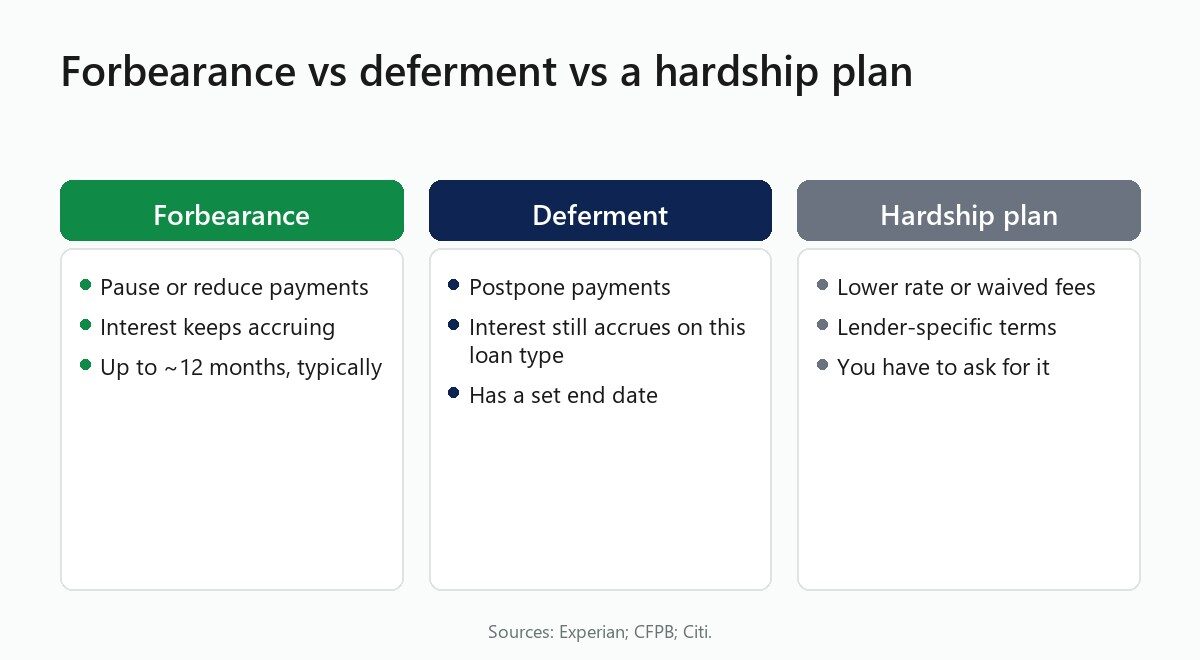
- Deferment is typically tied to a defined life event, hardship or military service among them, and interest "may pause... for certain loan types," in Citi's own hedged phrasing. Deferment isn't offered by every personal-loan issuer.
- Forbearance generally lets interest keep accruing throughout the pause, and unpaid interest can be capitalized, meaning it gets folded into your principal balance so you end up paying interest on the interest going forward.
- Hardship plan functions as an umbrella term. A lender might use it to describe either of the above, or a modified payment plan entirely, so the label alone doesn't tell you which mechanics you're actually agreeing to.
A personal loan hardship program is often the umbrella above deferment and forbearance both, bundling the new due date, the interest treatment, and the credit-reporting decision into one document you sign at the end of the call. Read that document line by line: it's usually the only fixed record of what your lender actually agreed to.
Don't assume based on which word a representative uses on the phone. Ask directly whether interest keeps accruing during the arrangement and whether missing the original due date gets reported to the credit bureaus. Write the answers down during that same call, since a program's name can shift once the representative starts pulling up your account specifics.
Why Interest Almost Always Keeps Accruing
This is the detail that catches people off guard once the arrangement ends: a paused payment rarely means paused interest. The skipped amount isn't forgiven. It comes back one of three ways, per Experian: as a lump sum due at the end of the forbearance period, as a surcharge tacked onto your future monthly bills, or as extra payments added to the end of your loan term.
The CFPB's guidance for auto-loan borrowers generalizes cleanly to any installment loan. A payment extension or deferral still accrues interest and can add payments to the end of the loan, and refinancing, another option some lenders offer, changes your rate and term without erasing the balance you owe. Every one of these paths increases the total interest you pay over the life of the loan, per the CFPB's guidance for borrowers struggling to make loan payments.
None of that is a reason to skip the call. It's a reason to make the call with clear eyes, weighing the cost of a few extra months of interest against the cost of a payment that reports as late.
Does Forbearance Hurt Your Credit?
The honest answer is that it depends on your lender, which is less satisfying than a flat yes or no but it's the accurate one. Lenders "aren't required to" note forbearance status when they report to the credit bureaus, per Experian's explainer on how forbearance affects credit.
If your lender does flag the account, that flag "is not considered negative information," per Experian, but whether it happens at all comes down to the lender's own policy about reporting forbearance payments to the national credit bureaus. Ask specifically, before you agree to anything, how the account will be reported during the arrangement, and get that answer in writing.
A lender can choose to report the account as current instead of delinquent while an arrangement is active, but nothing compels that choice. That's the real case for asking before you miss the payment: forbearance gives your lender an option to keep the account looking current, and silence gives them no reason to use it.
How to Ask for a Hardship Plan on a Loan: The Script
Call before you're late. The CFPB is direct on this point: "the sooner you contact your lender, the more choices the lender may be able to offer you." A call placed before the due date has more room to work with than one that's already routed your account to collections.
Before you dial, pull up your account number, confirm your next due date and payment amount, and have a one-sentence version of your hardship ready: reduced hours, a medical bill, a job loss. You don't need to over-explain. Once you're on the phone, work through these steps in order:
- Ask for the representative's name and, if they have one, their ID or employee number.
- Ask what hardship or forbearance options exist on your specific loan, and have each one explained: does it pause payments, extend the term, or just move the due date.
- Ask directly whether interest will continue accruing during the arrangement, and how any skipped payments get repaid.
- Ask specifically how the account will be reported to the credit bureaus during the arrangement, and whether that reporting treatment is guaranteed or up to the lender's discretion.
- Get a case number or reference number tied to the call.
- Ask for the agreement in writing, by email or mail, before you consider the matter settled. A verbal yes from a representative isn't something you can point to later if the account still reports as late.
If you'd rather build a paper trail from the start, ask for a hardship request form or send these same questions by email. Email moves slower than a phone call, but it creates a timestamped record without you having to take notes mid-conversation.
Once the written agreement arrives, read it before your next due date. Compare what it says about your payment schedule and interest against what the representative described on the phone, and call back right away if the two don't match. Watch your next statement too: if it still shows the original due date and a late fee, the arrangement likely didn't get applied the way you were told, and the case number from your call is exactly what you'll need to sort it out.
When Forbearance Beats Defaulting Outright, and When It Doesn't
Forbearance makes the most sense when your hardship has a visible end date: a seasonal layoff, a short medical leave, a temporary cut in hours. In that situation, extra interest for a few months is a real cost, but a bounded one, and it's traded against the alternative of missing the payment outright, which starts the clock toward a 30-, 60-, then 90-day-late mark and eventually toward collections. That missed-payment path is a longer one than most people expect walking in, and forbearance is one of the few tools that can keep you off that timeline entirely, provided the lender agrees to report it that way.
The math changes when the hardship isn't temporary. If your income has dropped permanently, or you're already stacking a forbearance request on top of several other accounts you're behind on, adding more accrued interest to one loan just delays a decision you can't avoid.
In that case, deciding which of several past-due loans to keep current matters more than buying one extra month on all of them. It's also worth asking your employer directly, since a hardship grant or paycheck advance offered through work can sometimes cover the gap without touching the loan at all. And if the loan itself is the wrong fit going forward, refinancing into a lower-cost option, a payday alternative loan through a credit union among them, is sometimes a better fallback on an account that no longer works for your budget.
What to Do If the Lender Says No
Not every lender offers forbearance, and not every request gets approved. Citi notes deferment is not something every personal-loan issuer offers, and the decision is the lender's to make: nothing in the CFPB's or Citi's guidance obliges one to say yes. If the answer is no, ask what the lender can offer instead: a modified payment plan, a partial payment arrangement, or refinancing into a different product.

If the lender won't budge at all, redirect your attention. Contact a nonprofit credit counselor before the due date passes, ask your employer about a hardship advance, or look at whether a lower-cost account could replace this loan going forward. Whatever you decide, don't let a declined forbearance request become a reason to stop communicating with the lender. A borrower who keeps calling generally has more options later than one who goes quiet.
Frequently Asked Questions
It means your lender has agreed to temporarily reduce or suspend your payments because of a financial hardship you've reported to them, though approval isn't guaranteed just because you ask. Interest generally keeps accruing on the balance while payments are paused, and the exact terms come down to your lender's own policy, according to Experian.
No. On personal loans, deferment is usually tied to a specific life event, like hardship or military service, and interest "may pause... for certain loan types," in Citi's own hedged language. Forbearance, according to Citi, generally lets interest keep accruing throughout the arrangement.
It depends on your lender's reporting policy. Lenders "aren't required to" note forbearance status when they report to the credit bureaus, and if they do note it, Experian says the flag "is not considered negative information." Because that treatment is discretionary, ask your lender exactly how the account will be reported during the arrangement.
Typical forbearance periods on personal and installment loans run up to about 12 months before regular payments must resume, according to Experian. Ask your lender for the specific maximum on your loan, since each lender sets its own cap.
Call your lender before the payment is due. Ask for the representative's name and, if they have one, their ID number, then ask whether interest keeps accruing and how the account will be reported to the credit bureaus. Get a case number, and ask for the agreement in writing, per the CFPB.
Generally not, on this loan type. The federal guarantee that interest stops accruing during a payment pause applies specifically to deferment on subsidized federal student loans; personal and installment loans fall outside that guarantee. Whether interest pauses at all on those loans is up to your individual lender's policy.