


Secured vs Unsecured Personal Loan: What Actually Protects You
One in five title loan borrowers loses their car or truck to repossession, according to a CFPB study of single-payment title loans. That statistic gets repeated to scare people away from secured lending in general, and it should scare you away from title loans specifically. But in a secured vs unsecured personal loan decision, "secured loan" covers a car title, a pawned guitar, and a savings account under the same label, and the risk behind each one is completely different.
If a lender or pawnbroker just told you collateral is the price of approval, the secured vs unsecured personal loan decision in front of you depends entirely on which kind of collateral is on the table. A title and a savings certificate are not the same bet, even though both get filed under the same word.
Every loan answers one question the moment you stop being able to pay it: what happens next? A secured loan answers with repossession, a forfeited pawn ticket, or a frozen savings account. An unsecured loan answers with a credit score drop, a collections call, and sometimes a lawsuit.
APR matters to this decision, but it isn't the whole decision. A missed payment on a secured loan costs you a physical thing you can see and touch today. A missed payment on an unsecured loan costs you a number that follows you into your next credit application, your next apartment lease, and possibly your next job screening.
What You Actually Lose If You Cannot Pay
Subprime and near-prime borrowers drove a 32.5% year-over-year increase in personal loan originations, per TransUnion's Q1 2026 industry report, which forecasts 60-plus-day delinquency on unsecured personal loans running around 3.75% for 2026. That growth is not an accident. Lenders manage rising bad-credit demand by pushing more applicants toward secured products, since collateral moves default risk off the lender's books and onto whatever the borrower pledged.
This is the tradeoff worth writing down before you sign anything. Pledge a car title, a pawned item, or a savings balance, and default caps your loss at that specific asset, plus in some cases a bruised credit file. Skip collateral and take an unsecured loan instead, and default caps your financial loss at zero physical property.
What an unsecured default opens instead is a damaged credit score, debt collectors, and, on a large enough balance, a civil judgment. Neither path is automatically safer. The right one depends on what you are pledging and what you can actually afford to lose.
Unsecured default does not stay contained to one account. A charged-off balance typically gets sold to a collections agency and sits on your credit report for years, a cost that compounds well past the original loan. None of that requires you to have signed away a physical asset first.
Four Secured Loan Types, and Which Ones Are Worth the Risk
Every product below counts as "secured," yet they sit at opposite ends of the risk spectrum. Sorting them by what they actually cost, and what they actually put at risk, matters more than the label on the loan application.
Approval difficulty moves in roughly the same order as risk. A title loan or a pawn loan can close in under an hour, since the lender or pawnbroker needs little beyond the item or the clear title itself. A secured personal loan takes longer, because a mainstream lender still checks income and credit history on top of the collateral.
A share-secured loan is the easiest of all to get approved for, provided you already have savings sitting in the account to pledge. That single requirement, having money to put up in the first place, is exactly why it isn't an option for every bad-credit borrower walking through this decision.
Title loans: predatory-adjacent
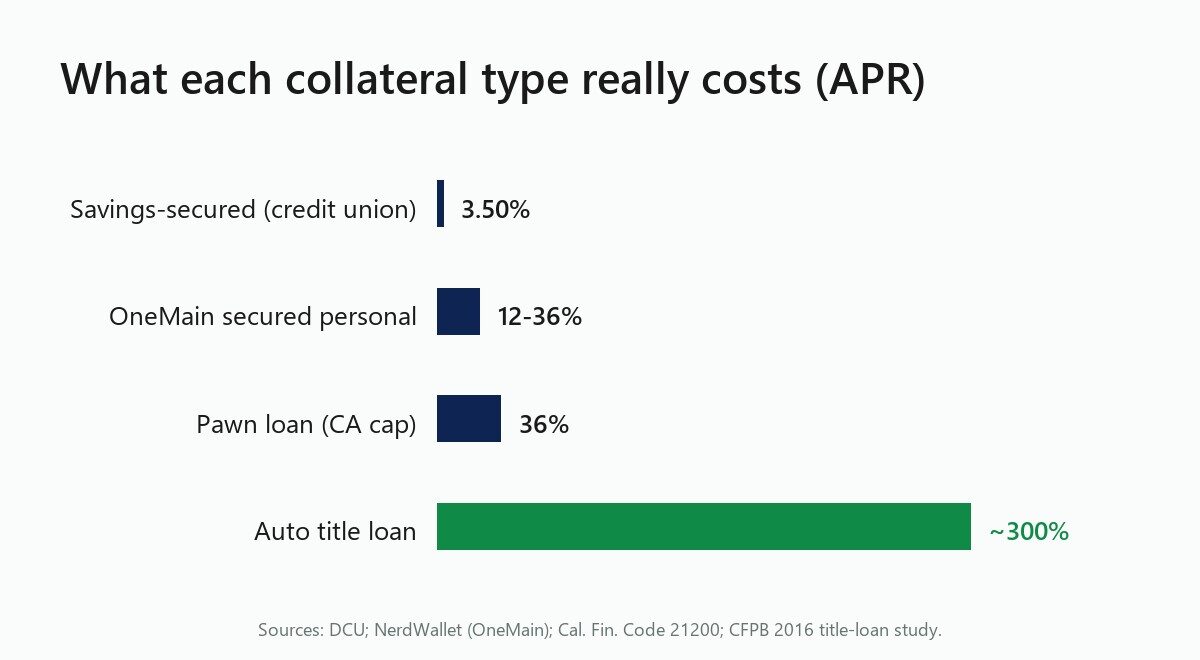
The CFPB's 2016 study of 3.5 million single-payment title loans made between 2010 and 2013 found that "the typical loan is about $700 and the typical annual percentage rate is about 300 percent... One-in-five borrowers have their car or truck seized or repossessed by the lender for failure to repay." Approval is fast precisely because the lender has already priced in high odds of repossession.
Speed here is priced repossession risk, not reassurance. Ask the lender in writing, before you sign, whether they can pursue you for a shortfall if a repossession sale does not cover the balance.
Quick5k has already built the full case against this product. Read why we never recommend a title loan for the deeper breakdown rather than repeating it here.
Pawn loans: legitimate, but priced by your state
A pawn loan works differently from every other secured product on this list. Hand over an item, walk out with cash, and if you never come back to redeem it, the pawnbroker keeps the item and the debt ends there. No collections call follows you, and pawnshops generally do not report to the credit bureaus.
California caps pawnbroker interest at 3% per month, or 36% APR, on the unpaid balance, per California Financial Code Section 21200. State pawnbroker laws vary widely elsewhere, often 3% to 25% of the loan per month, so check your own state's pawnbroker cap before assuming California's number applies to you.
Rate is the wrong thing to worry about with a pawn loan. Worry about the item. If what you're pledging is irreplaceable, a family heirloom or something with sentimental value you cannot rebuy, weigh that loss before you weigh the APR. For the fuller tradeoff between a pawn loan and an online installment loan covering the same dollar amount, see the deeper pawn-vs-installment-loan tradeoff.
Secured personal loans
A secured personal loan pledges an asset, often a vehicle, to a mainstream installment lender in exchange for a lower rate than that same lender's unsecured product. OneMain Financial, one of the larger names in this space, discloses an overall personal loan APR range of 11.99% to 35.99% and accepts vehicles under 10 years old as collateral, with its lowest advertised rates generally reserved for secured agreements and stronger credit files, per a NerdWallet review of OneMain Financial.
That range belongs to one lender, not the industry, so treat it as an example of how secured pricing works rather than a number every lender will match. Approval still requires income verification on top of the pledged asset, which makes this tier moderately harder to qualify for than a pawn or title loan.
Share-secured and savings-secured credit union loans
This is the cheapest tier of secured borrowing, and it only works if you already have savings to pledge. Digital Federal Credit Union (DCU) advertises savings-secured loans as low as 3.50% APR, plus certificate-secured loans priced at the certificate's own dividend rate plus roughly 3 percentage points (a 0.90% certificate becomes a 3.90% APR loan, for example).
Most credit unions price share-secured loans in a similar range, generally 2 to 3.5 points over whatever your savings account or certificate is already earning. Federal credit unions also operate under a federal rate ceiling on credit union loans, currently 18% APR under the NCUA Board's temporary ceiling, which is part of why this entire product tier prices so far below title and pawn loans.
The only thing at risk here is access to your own pledged savings until the loan is repaid. There is no outside asset in play, no vehicle, no heirloom, nothing you'd miss if the balance simply gets applied against what you borrowed.
When Pledging Collateral Actually Makes Sense
Two scenarios justify handing over collateral. The first is a share-secured or credit-builder loan when you already have savings sitting in an account earning close to nothing. You pledge the balance, borrow against it at a modest markup, make on-time payments, and build payment history without risking anything beyond temporary access to money you already had.
The second is a secured personal loan for a genuine one-time need, a car repair or a medical bill, where you have a concrete repayment plan and the lower secured rate meaningfully beats what you would pay unsecured. Underwriters approving these loans often look past a thin credit file to alternative data: rent payments, utility history, and bank account cash flow.
If you have been told you have no credit score, that alternative file is worth understanding before you assume collateral is your only path to approval. See the alternative credit file lenders check before offering a secured loan.
When Secured Is a Trap
Collateral stops making sense the moment its value dwarfs the amount you are borrowing. A $2,500 title loan against a car worth $12,000 hands the lender enormous leverage over a small balance, and that lopsided math is a large part of why one in five borrowers loses the car.
The same logic applies to pawning an item worth several times the loan amount in a state with a weak rate cap. Any secured offer that skips a hard look at your ability to repay, relying on the asset alone as insurance, is a warning sign regardless of what label the lender uses.
Fast approval that hinges entirely on what you stand to lose is not the same thing as a safe loan. Speed and safety get confused constantly in this market, and they are measuring two different things.
The Unsecured Alternative Worth Checking First
Before you pledge anything, price out the unsecured side properly. The average unsecured personal loan APR sits around 12.42% for a borrower with roughly 700 FICO, per Bankrate's July 2026 rate survey, and credit unions run even lower: 10.64% APR on 36-month unsecured personal loans in Q4 2025, versus 12.00% at banks, per NCUA's own rate comparison.

Your bad-credit unsecured personal loan APR will land well above that good-credit average, often into the high-20s to mid-30s depending on the lender. Qualifying without collateral or a co-signer costs more, because you are offering the lender less protection.
Check whether your local credit union offers a Payday Alternative Loan, capped at 28% APR under National Credit Union Administration rules, before assuming that rate is out of reach; most bad-credit borrowers never hear about it. See a credit union option capped at 28% APR.
A scary APR looks different in dollars. Translate it before it talks you into collateral you would rather not risk. See how to translate a scary APR into real dollars, since a high rate on a small, short balance often costs far less than the number itself suggests.
Pricing a bad-credit unsecured loan and deciding whether to pledge collateral are the same question asked twice: how much risk can you absorb right now? A borrower with an emergency fund and no attachment to the item being pledged can reasonably accept a secured loan's asset risk in exchange for a lower rate. A borrower who cannot afford to lose the car they drive to work is often better off paying more for an unsecured loan and keeping the vehicle out of the transaction entirely.
A Decision Checklist Before You Pledge Anything
Work through these five questions before you sign a secured loan agreement of any kind.
- What exactly am I pledging, and could I actually afford to lose it permanently, not just financially but personally?
- Is the collateral's value close to the loan amount, or does it far exceed what I am borrowing?
- Have I priced the unsecured alternative, including a credit union PAL, before assuming collateral is required?
- Does this lender check my ability to repay, or is the loan approved on the asset alone?
- If I default, does the lender's contract let them pursue me for a balance after they take the collateral, and have I asked that in writing?
Frequently Asked Questions
Neither is universally safer. A secured loan is the better call when the collateral is something you can afford to lose and the rate runs meaningfully lower, like a share-secured credit union loan. An unsecured loan wins when the collateral would be a car you need for work, since the downside there stays capped at your credit score.
A title loan uses your vehicle as collateral while you keep driving it, carries roughly 300% typical APR per the CFPB, and puts you at real risk of losing the car through repossession. A pawn loan uses a physical item you hand over immediately; default simply forfeits that item, generally with no debt or credit report impact following you.
You lose access to the savings or certificate balance you pledged, since the credit union applies it against your remaining loan balance. No outside asset, like a car or home, is at risk. This is why share-secured and savings-secured loans carry the lowest rates and the lowest overall risk among secured products.
Lenders price unsecured loans on your perceived ability and willingness to repay, with no asset backing the loan if you don't. Good-credit borrowers average close to 12% APR per Bankrate, while bad-credit unsecured rates climb well above that, often into the high-20s to mid-30s, since the lender takes on more risk without collateral offsetting it.
It depends on your contract and state law. Before you sign anything, ask the lender in writing whether they can pursue you for a shortfall if a repossession sale does not cover the full loan balance. Get that answer on paper, not a verbal assurance, so you know your real exposure going in.