

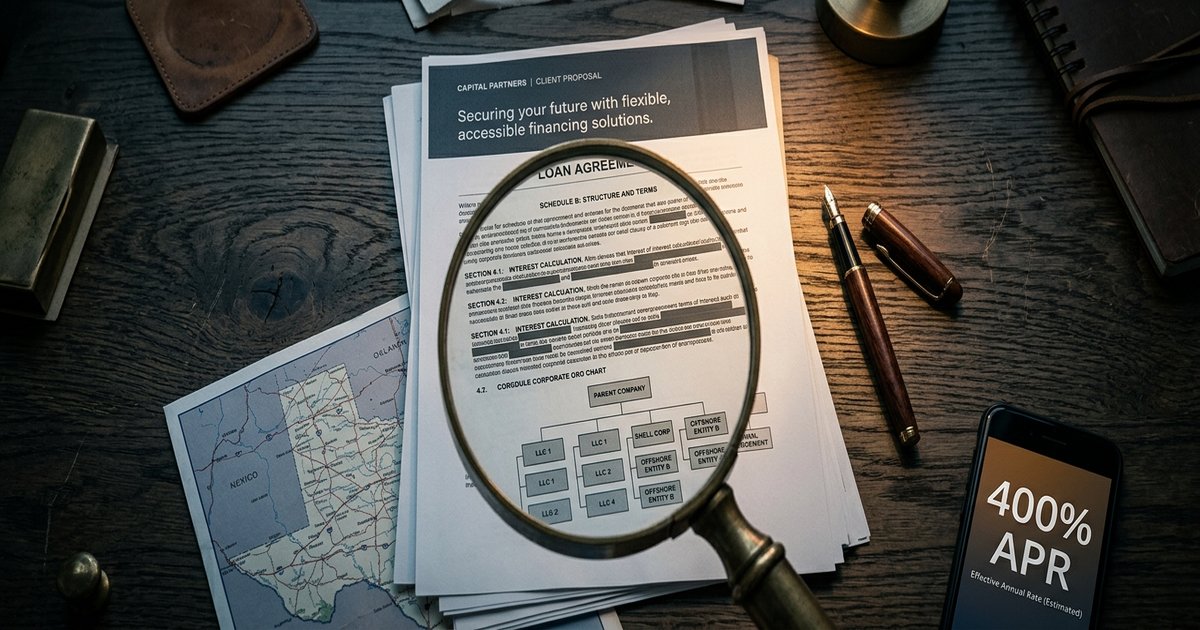
When a tribal lender tells you "state laws do not apply," what they are really saying is that sovereign immunity protects the tribe and the tribal-owned business from being sued in state court. It does not protect you. And it does not turn the lender into a law-free zone. Federal consumer protection statutes still apply: Truth in Lending, the Fair Debt Collection Practices Act, UDAAP, and the Military Lending Act. On top of that, plenty of operations marketed as "tribal lenders" are actually "rent-a-tribe" arrangements where a non-tribal company runs the entire lending business and pays a tribe a fee for cover, and courts have stripped those of immunity. The APRs typically run 200 to 600 percent. Before you sign anything, your job is to verify the specific federally recognized tribe, check for NAFSA membership, identify the tribal regulator, and search for enforcement actions against the parent company.
Somebody just offered you a $1,500 installment loan from a lender with a name like "Plain Green," "Big Picture Loans," or "Spotloan." The website says the lender is owned by a federally recognized Native American tribe and operates under tribal law. The APR you are being quoted is 300 percent. The fine print says any dispute goes to a tribal arbitration panel in another state.
Is this loan legal? Is the lender legitimate? Can they actually collect from you? And what does "sovereign immunity" mean for the person sitting in the borrower's chair?
Let me untangle this. Some tribal lenders are genuinely tribally owned and operated, with real economic-development missions. Others are non-tribal businesses paying a tribe a small fee to use sovereign-immunity language as a shield. The marketing usually does not make the difference clear. Your job, before you sign, is to figure out which one you are looking at.
What a Tribal Lender Actually Is
A tribal lender, in the legitimate sense, is a small-dollar lending business owned and operated by a federally recognized tribe. Because the tribe is a sovereign government, the business operates under the tribe's own commercial code rather than under state lending laws. That can mean rates and terms that would not be allowed under your state's payday or installment lending statute.
The trade association in this space is the Native American Financial Services Association (NAFSA), founded in 2012. NAFSA represents roughly a dozen tribes engaged in online small-dollar installment lending and publishes a voluntary best-practices code. Membership in NAFSA does not automatically mean a lender is consumer-friendly, but it is one signal that the business is at least claiming to follow industry standards on disclosures, dispute resolution, and military protections.
What Sovereign Immunity Does (and Does Not) Do
Sovereign immunity is the legal doctrine that a sovereign government cannot be sued without its consent. For a federally recognized tribe, the Supreme Court has consistently held that immunity applies to tribal businesses (commercial activities of the tribe itself), with some boundaries. The case to know is Michigan v. Bay Mills Indian Community, 572 U.S. 782 (2014).
Here is what sovereign immunity does for the lender:
- The tribe (and its tribal-owned business) generally cannot be sued in state court for violating state lending caps.
- Disputes are usually routed to a tribal forum, sometimes the tribe's own arbitration panel.
Here is what sovereign immunity does not do:
- It does not stop federal consumer financial laws from applying. The CFPB has consistently asserted that UDAAP, Truth in Lending, the Fair Debt Collection Practices Act, and the Military Lending Act apply to tribal lenders.
- It does not shield non-tribal partners. If a non-tribal company is the "true lender" using the tribe as a front, courts have repeatedly stripped the immunity defense from the non-tribal entity.
- It does not strip a borrower's federal statutory rights. Courts have voided some tribal arbitration clauses as illegal "prospective waivers" of federal rights. See Hayes v. Delbert Services Corp., 811 F.3d 666 (4th Cir. 2016).
- It does not erase the debt or grant the borrower immunity. You still owe the loan. The question is who can collect it, where, and under what rules.
If a tribal lender's marketing implies that "state laws do not apply" and therefore "anything goes," that is the marketing oversimplifying. Federal laws still apply. And state attorneys general have repeatedly gone after non-tribal partners in rent-a-tribe arrangements.
The "Rent-a-Tribe" Problem
This is the part that catches the most borrowers off guard. A rent-a-tribe operation is structured like this: a non-tribal company runs the lending business (marketing, underwriting, servicing, collections), but pays a federally recognized tribe a fee to put the tribe's name on the paperwork. The tribe earns a small slice. The non-tribal partner keeps the rest.
Courts have looked at these arrangements and asked: who is the true lender? Who bears the predominant economic interest, makes the lending decisions, and funds the loans? If the answer is the non-tribal partner, the tribal immunity argument collapses.
The teaching case is CFPB v. CashCall. CashCall was a non-tribal lender that originated loans through Western Sky, a business affiliated with a member of the Cheyenne River Sioux Tribe, and then immediately purchased the loans. Courts found that CashCall (not Western Sky) was the true lender because it bore the predominant economic interest in the loans. The Supreme Court denied certiorari on March 2, 2026, leaving in place roughly $134 million in restitution and a $33.28 million civil penalty.
The takeaway for borrowers: a marketing claim of tribal ownership does not, by itself, mean state law does not apply. And it does not mean the lender can do whatever it wants.
APRs and Total Cost: What 200 to 600 Percent Looks Like in Dollars
Tribal installment loans commonly carry APRs of 200 to 600 percent, with some over 700 percent. The Pew Charitable Trusts and multiple state AG enforcement records have documented this range across the industry.
Let us put it in dollar terms. A $1,000 tribal installment loan at 400 percent APR, amortized over 9 months, will cost roughly $1,800 to $2,200 in interest on top of the $1,000 principal. Total payback: $2,800 to $3,200.
For comparison:
- A $1,000 PAL II from a federal credit union (capped at 28 percent APR plus $20 fee) over 9 months: total cost around $130 in interest plus $20 fee. See our PAL guide.
- A $1,000 state-licensed installment loan at 36 percent APR over 9 months: roughly $170 in interest.
- A $1,000 tribal loan at 400 percent APR: $1,800 to $2,200 in interest.
Same starting loan. Roughly the same term. Up to 15 times the interest cost. That is the gap the marketing does not show you. Our APR translation guide walks through how to spot that math on the disclosure.
The 6-Point Borrower Checklist Before You Sign
If you are evaluating a tribal-affiliated loan offer right now, run through these six checks before you click submit.
1. Verify tribal ownership. Look for the specific tribe named on the lender's website. Federally recognized tribes are listed on the Bureau of Indian Affairs website. Confirm the lender claims ownership by an actual recognized tribe, not just a vague "Native American" reference.
2. Check for NAFSA membership. Visit nativefinance.org and look at the member list. NAFSA membership is voluntary and not a guarantee of fair pricing, but it is one signal that the lender claims to follow industry best practices on disclosures, military protections, and dispute resolution. Non-members are not automatically rent-a-tribe operations, but the membership check costs nothing.
3. Read the arbitration clause carefully. Many tribal lender contracts route disputes to a tribal arbitration forum, often in another state. Courts have voided some of these clauses as prospective waivers of federal rights. If the clause says you cannot pursue federal statutory claims like FDCPA or TILA, that is a red flag.
4. Search the CFPB enforcement database. Go to consumerfinance.gov, search the consumer complaint database for the lender's name and any non-tribal affiliated companies. Check the CFPB enforcement actions page. If the lender or a parent company has been the subject of a federal action, you want to know that.
5. Check the tribal regulatory authority. Legitimate tribally owned lenders are typically licensed by a tribal regulatory body. The website should name the regulator. If the regulator does not exist or cannot be verified, treat that as a serious red flag.
6. Compare to a state-licensed alternative. Before you sign, pull a quote from a state-licensed installment lender, a credit union for a PAL, or an employer-sponsored EWA program. If the tribal lender's all-in cost is materially higher (and it usually is), the question is whether the speed and access are worth the difference.
Real vs. Rent-a-Tribe: The Pattern Match
Genuine tribally owned lenders generally:
- Name a specific federally recognized tribe and identify their tribal regulatory authority.
- Disclose ownership and economic structure in plain language.
- Provide military-protection disclosures (MLA at 36 percent for active duty and dependents). See our MLA explainer.
- Direct part of revenue to tribal community programs.
- May still charge high APRs, but the disclosures are upfront.
Rent-a-tribe operations tend to:
- Lead with phrases like "state laws do not apply" rather than naming the tribe.
- Bury the tribal connection in fine print while marketing under a non-tribal brand name.
- Route all servicing and collections through a non-tribal company.
- Use arbitration clauses that block federal statutory claims.
- Appear in CFPB or state AG enforcement records under the non-tribal parent's name.
What Quick5k's Lending-Partner Network Actually Does
To be direct about positioning. Quick5k is a lending-partner network. Our network connects borrowers with state-licensed lenders offering loans in the $500 to $5,000 range. We are not a lender, broker, review site, or comparison site. We do not include tribal-affiliated lenders in the network. Our partners are licensed in the states where they operate.
That positioning is editorial. Tribal lending is not illegitimate as a category, and many tribal economic-development missions are real. But the borrower-side decision is hard to navigate, and the rent-a-tribe risk is real enough that we keep the network to state-licensed partners where you can verify the license through your state's banking or financial regulator. If you live in a state where storefront payday lending is restricted, our payday-ban state guide covers the legal alternatives.
If You Already Took a Tribal Loan and Feel Misled
Three things you can do right now.
1. Do not just stop paying. A blanket "sovereign immunity does not apply to me" argument is not a defense to non-payment, and it can make your situation worse. Even if the lender's structure is shaky, you still have a contract.
2. File complaints in parallel. File with the CFPB, with your state attorney general, and with your state's banking or financial regulator. State that you believe the loan terms violate state law or that the lender's tribal affiliation appears to be a rent-a-tribe arrangement. Attach the loan agreement. Be specific about the rate, the fees, and the dispute clause. Our complaint playbook covers the filing process.
3. Get legal help. Contact a legal aid clinic in your state through the Legal Services Corporation, or the National Consumer Law Center for referrals. A consumer protection attorney can read the actual loan documents and tell you whether you have standing to challenge the contract. Some tribal loan contracts have been voided in litigation. Yours might be. Or might not. You need someone to read it.
Frequently Asked Questions
The legal status hinges on whether the lender is doing business "in" your state and whether the tribal-ownership structure actually holds up. Some state attorneys general have pursued tribal-affiliated lenders for operating without a state license. Others have not. Avoid assuming the loan is "definitely legal" or "definitely illegal." Check with your state attorney general's consumer protection division before you sign.
Sovereign immunity is the doctrine that protects a tribe from being sued without its consent. It applies to the tribe and tribal-owned businesses. It does not apply to you as the borrower. You can still be sued for non-payment (subject to whatever forum the contract specifies), your wages can be subject to administrative wage assignment in some states, and your checking account can be debited if you have authorized ACH. The shield protects the lender, not you.
Run the 6-point checklist above. Look for a specifically named federally recognized tribe, NAFSA membership, a real tribal regulatory authority, transparent ownership disclosure, and absence from CFPB enforcement actions against non-tribal partners. Rent-a-tribe operations typically lead with sovereign-immunity language while the actual business is run by a non-tribal company.
Because they are usually operating outside state rate caps. When state law caps an installment loan at 36 percent and a tribal lender is not bound by that cap, the pricing can run 200 to 600 percent or higher. The marketing usually frames this as "no credit check" or "fast approval" rather than as a rate disclosure.
It depends on the contract and your state's law on out-of-state and tribal court judgments. Some borrowers have had wages administratively assigned through ACH authorizations they signed at closing, which is functionally a payroll deduction. Whether a tribal court judgment is enforceable in your state's courts is a more complicated question and varies. Talk to a consumer protection attorney if you are facing collection.
Same general process as defaulting on any consumer loan: late fees, repeated collection attempts, possible ACH debits on the account on file, eventual referral to a collections agency, and potential reporting to the credit bureaus (some tribal lenders report, some do not). The lender will often invoke the tribal arbitration clause if you dispute. Your federal statutory rights under FDCPA and similar laws still apply to the collection conduct, regardless of where the lender is based.