If you're pricing out a California Check Cashing payday loan, state law sets exactly what the store can charge you. As of a January 2019 state settlement, the company operated 118 California locations.
The charge is capped by statute, and the cap produces a triple-digit annual percentage rate even though the dollar fee looks modest on paper.
California Check Cashing Stores, LLC is a real, licensed operator with a corporate parent behind it. It's a subsidiary of Direct Financial Solutions, LLC. As of the 2019 settlement, it was owned by Community Choice Financial, Inc., the same parent company behind CheckSmart, Cash & Go, and several other storefront brands operating across multiple states.
Here's what the California Deferred Deposit Transaction Law actually caps on this store's payday product, what a second license lets the same company sell under different rules, what state regulators caught it doing in 2019, and where you can borrow the same amount for less.
The number that matters is the one printed on your written loan agreement, and it should never exceed the statutory math below. If the fee on your paperwork runs higher than that math allows, that discrepancy is worth questioning before you hand over a check.
The $300 Check, CDDTL Loan Limits, and the Real APR
California's Deferred Deposit Transaction Law, commonly called the CDDTL, is the statute that governs payday loans in the state. Under Cal. Fin. Code § 23035, a licensed deferred deposit originator can't write a check for more than $300, and the fee it charges can't exceed 15% of that check's face value.
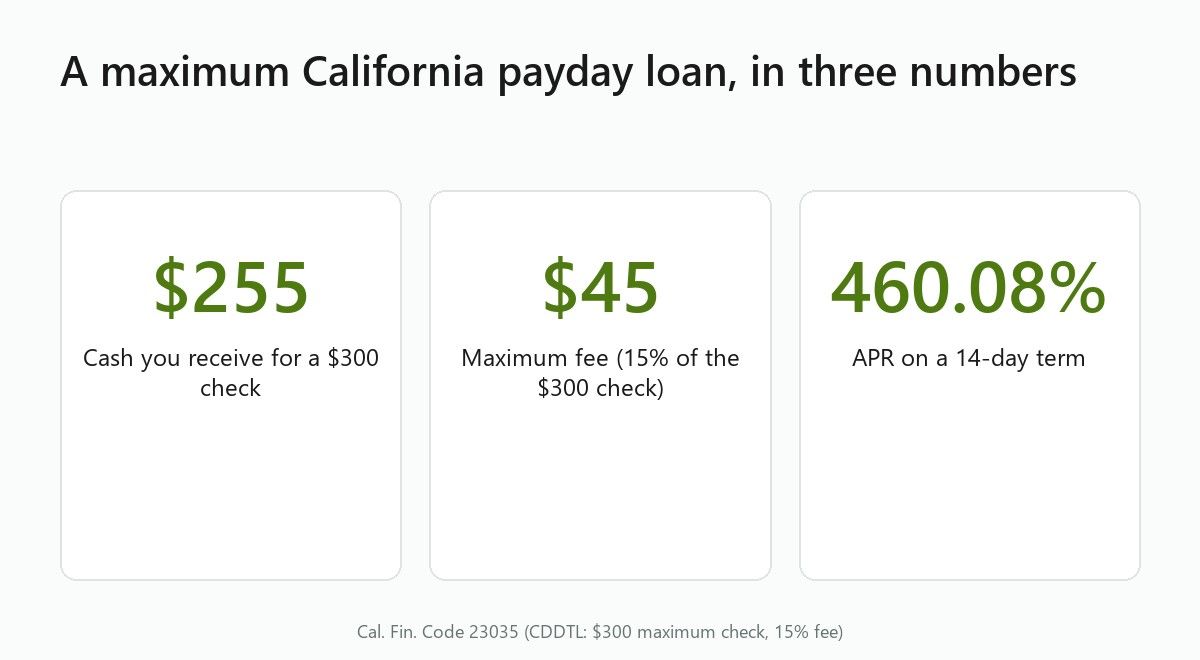
Run the math on the maximum loan allowed. A $300 check at a 15% fee costs you $45. Subtract that fee from the face value and you get the cash actually advanced: $255. So you hand over a $300 check, you walk out with $255, and in roughly two weeks you owe the full $300 back.
Converted to an annualized rate, that $45 fee on $255 borrowed over a 14-day term works out to 460.08% APR. Here's the arithmetic: $45 divided by $255 is 0.1765, or 17.65% for the loan term. Multiply that by the number of 14-day periods in a year (365 divided by 14, or roughly 26.07) and you land at 460.08%.
That figure is the maximum the CDDTL permits on the largest check any storefront can legally write, and it applies to every CDDTL-licensed payday lender in the state. 15% of $300, or $45, is the legal ceiling on the fee, not a fee every lender necessarily charges; a licensee is free to charge less.
A triple-digit APR on a two-week loan looks alarming next to a credit card rate, but the percentage and the dollar cost measure different things. For a full breakdown of why a scary-looking APR can still mean a small dollar cost on a short loan, see this site's guide to APR math on short-term loans. The $45 fee is real money regardless of how you measure it, and it's the most that should show up on your paperwork for a $300 check.
The Other Product: CFL Installment Loans Over $2,500
The CDDTL isn't the only license this company holds. California Check Cashing Stores also operates under a California Financing Law (CFL) license, and it uses that license to make installment loans starting at $2,500 and up, a completely separate statute from the one governing its $300 payday product.
Before 2020, the CFL had no interest-rate cap on loans above $2,500. That gap mattered, because a lender could avoid the CDDTL's fee limits entirely by structuring a loan just over that threshold, moving a borrower who needed a few hundred dollars into a much larger product with no statutory ceiling on what it could charge. The California Fair Access to Credit Act (AB 539) later closed much of that loophole for loans between $2,500 and $9,999, tying rates to 36% annual simple interest plus the Federal Funds Rate, per AB 539's bill text, which added Financial Code Section 22304.5.
That reform took effect after the enforcement action described below, and it's part of why the specific gap the state caught this company exploiting no longer works the same way today. This article can't tell you what CCCS charges on its current installment product; that figure wasn't independently confirmed for this piece, so it isn't printed here. If you're weighing a loan above $2,500 from this or any CFL licensee, ask the loan officer directly for the annual percentage rate in writing before you sign, and compare it against the AB 539 benchmark yourself.
What the State Caught CCCS Doing in 2019
On January 22, 2019, California's Department of Business Oversight, the agency now known as the Department of Financial Protection and Innovation (DFPI), entered a consent order with California Check Cashing Stores. That's a signed settlement, past the complaint or allegation stage.
According to Press Democrat reporting on the order, the state's predecessor agency found that CCCS steered borrowers into CFL installment loans above $2,500 specifically to avoid the interest-rate caps that applied below that threshold, the uncapped gap the law hadn't yet closed. Regulators also found the ads implied loans smaller than $2,501 were available when they were not.
The total settlement came to $905,000. That broke down into $105,000 in costs and penalties, roughly $100,000 refunded across about 1,200 CFL installment loan transactions, and roughly $700,000 refunded across about 3,000 CDDTL payday loan transactions. The headline finding in the order was the CFL rate-cap avoidance and the false "up to $5,000" advertising.
But the order also found payday-side violations. On roughly 3,000 CDDTL transactions, CCCS collected charges twice, let some customers take out a new loan before an old one was paid off, and deposited some customers' checks earlier than their loan agreement allowed, without written authorization. That's a separate problem from the 15% fee cap itself, which the order did not find CCCS violated.
That combination, the double-charging, the back-to-back loans, and the early check deposits, is why nearly $700,000 of the restitution landed in CDDTL payday accounts even though the headline finding was on the installment side. That detail matters if you're trying to size up the company's track record: real money moved out of payday customers' pockets too, just for different reasons than the fee math. The $45-per-$300 fee itself was never the problem the state identified; the problems were the extra charges layered on top of it and the loan-structuring on the installment side.
Cheaper Ways to Borrow the Same Amount in California
If you need $300 or $500 fast, a CDDTL payday loan at this store or any competitor isn't the only door open to you. A few state-regulated alternatives cap the rate far below 460%.
Say you need $300 to cover a car repair before your next paycheck lands in ten days. A CDDTL payday loan gets you the cash same-day, but it costs $45 for those ten days if you're at the maximum fee. The alternatives below take a little more paperwork up front, sometimes a same-day answer and sometimes a day or two, but the fee on a comparable loan amount runs a fraction of what a check cashing storefront charges.
Credit union payday alternative loans
If you belong to a federal credit union, or can join one, ask about a credit union Payday Alternative Loan. The National Credit Union Administration permits federal credit unions to charge up to 28% APR on these loans; the site's own guide to credit union Payday Alternative Loans has more detail. That original PAL structure covers loans up to $1,000 with terms from one to six months. A newer version added in 2019, generally called PALs II, allows loans up to $2,000 with a 12-month repayment window.
Both cap the rate at a small fraction of what a two-week CDDTL loan charges, and the longer repayment window means you're not staring down the full balance in fourteen days. You'll need to check membership eligibility with a specific credit union before you can apply. For the mechanics, eligibility rules, and how to find a participating credit union, the linked guide above covers it in depth.
California's small-dollar loan pilot program
The state runs its own lower-cost lane for loans in this range. California's Pilot Program for Increased Access to Responsible Small Dollar Loans lets CFL-licensed lenders that get approved into the program offer installment loans starting at $300 under terms structured specifically to serve borrowers who'd otherwise turn to payday lending. The program exists precisely to fill the gap between a $300 payday loan and a full-size installment loan.
Ask a participating lender for its current rate and terms before you apply anywhere, since the program's rate structure and which lenders take part can both change. If you'd prefer a mission-driven lender over a storefront chain, a community development financial institution (CDFI) is another avenue worth asking a local credit union about, though you should confirm any specific rate directly with the lender.
If you're not in California
Payday loan rules vary sharply by state. Some states cap fees the way California does; others ban the product outright and route borrowers toward different regulated products entirely, and a handful leave the market largely uncapped, which changes the math in this article considerably. If you're reading this from outside California, this guide to what's legal in states that restrict payday lending breaks down what applies where you live, since none of the CDDTL specifics above transfer automatically to a different state's statute.
What to Do Before You Sign
Before you walk out of any check cashing storefront with cash in hand, confirm three things on the disclosure the clerk hands you. First, check that the fee matches the 15% cap: on a $300 check, the fee should be no more than $45. Second, look at the APR box on the disclosure; it should show a number close to 460% for a 14-day term, and if it's higher, ask why. Third, ask what happens if you can't repay on the due date.
Keep a copy of everything you sign, including the itemized fee breakdown, and write the due date somewhere you'll actually see it before it's due. A missed due date on a deferred deposit transaction means the check gets presented for payment, and if your account can't cover it, your bank may charge you separately for the returned item, on top of whatever the store charges.
If the math doesn't work for your paycheck timeline, call a local credit union about a PAL before you sign anything, and check the DFPI pilot program lender list for an installment option built for exactly this loan size. A five-minute phone call can save you hundreds of dollars over a single payday cycle.
Frequently Asked Questions
Yes. It operates under a California Deferred Deposit Transaction Law license for its payday product, the same license category any storefront payday lender in the state must hold. It separately holds a California Financing Law license for its larger installment loans.
Under Cal. Fin. Code § 23035, the fee can't exceed 15% of the check's face value, and the check itself can't exceed $300. That caps the maximum fee at $45 on a $255 cash advance, which annualizes to 460.08% APR over a standard 14-day term.
Annual percentage rate annualizes the cost of a short loan. A $45 fee on $255 borrowed for 14 days, repeated across a year's worth of 14-day cycles, works out to 460.08%. The dollar cost of one loan is $45; the APR shows what that cost looks like stretched over a full year.
The 2019 order did find payday-side violations: collecting fees twice on about 3,000 CDDTL transactions, letting customers take new loans before repaying old ones, and depositing checks early without authorization. It did not find a 15% fee cap violation. The headline finding was steering borrowers into CFL loans over $2,500 to dodge rate caps, plus false "up to $5,000" ads.
A federal credit union Payday Alternative Loan caps rates at 28% APR for loans up to $1,000 or $2,000, well below a CDDTL payday loan's rate. California's small-dollar loan pilot program also offers installment loans starting at $300 through approved CFL lenders at rates structured to undercut payday pricing.
California Check Cashing Stores, LLC is a subsidiary of Direct Financial Solutions, LLC, which was owned by Community Choice Financial, Inc. as of a 2019 state settlement. The same parent operated other storefront brands, including CheckSmart and Cash & Go. At the time of that settlement, the company ran 118 California locations.