


How to Get a Short-Term Loan: The Real Steps and What to Try First
A short-term loan, a small-dollar loan usually running $500 to $5,000 and repaid within a few months to about a year, is what most people mean when they search "how to get a short-term loan" at eleven at night. You already know you need the money. The car needs a water pump, rent is due before the next check clears, or a bill landed sideways when you weren't ready for it. Maybe it is a medical copay that cannot wait for the next paycheck, or a repair estimate that came in higher than the number you had in your head.
Skip the lecture on whether to borrow. What you need is the actual sequence, done right, so you do not pay more than the situation actually requires.
That sequence runs five steps. At each one, there is a cheaper option worth checking before you commit to the loan version, because skipping that check is how borrowers end up paying far more than the situation required.
I have watched the same two mistakes trip up borrower after borrower. The first is skipping the alternatives entirely and applying at the first storefront or app that shows up in a search. The second is fixating on the weekly payment number and never checking the loan's actual total cost. Fix those two habits and you have already avoided most of the trouble that short-term borrowing causes.
What to Gather Before You Apply
Every step below moves faster if you have the basics ready first. Most short-term lenders ask for some version of the same documentation, whether you apply online or walk into a branch.

- A government-issued photo ID that matches the name on your bank account
- Proof of income: recent pay stubs, a benefits statement, or bank deposit history if you work gig or freelance jobs
- Your bank account and routing numbers for the account that will receive the funds and make the payments
- A working phone number and email address the lender can use to verify your identity
Having these ready before you start the eligibility check saves you from restarting an application halfway through because a lender's portal timed out waiting on a document you had to go dig up.
Step 1: Check Your Eligibility Before You Apply
Short-term lenders look for three things before anything else: an active checking account, income they can verify, and proof you meet the minimum age and state residency rules. Some lenders skip a hard credit check entirely and advertise it loudly. That does not mean they skip scrutiny. They still want bank statements, pay stubs or direct-deposit history, and a working account that has been open long enough to show a pattern.
"Verifiable income" covers more than a W-2 paycheck. Lenders that work with short-term borrowers regularly accept 1099 or gig income, Social Security or disability benefits, and consistent bank deposit history if you do not have a traditional pay stub. What trips people up at this stage is usually the math: if the payment would eat too much of your verified income, expect a smaller approved amount or a denial, regardless of how clean your credit history looks.
Alternatives gut-check: before you fill out any application, find out what your employer might already offer for free. Some workplaces already run hardship funds or advance-pay programs that cost nothing and never touch your credit file. It is also worth checking what earned wage access apps can legally offer in your state, since those rules can differ sharply depending on where you live.
Step 2: Prequalify With a Soft Pull, Not a Hard One
Prequalification and formal application are not the same move, and mixing them up costs points on your credit report. A soft inquiry, the kind lenders use to show you estimated rates before you commit, will not affect your credit scores, according to the Consumer Financial Protection Bureau. A hard inquiry, triggered once you formally apply and the lender pulls your full file, typically costs fewer than 5 points and stays in the 12-month scoring window before falling off your report after two years, according to FICO's own data.
A prequalification form usually asks for your name, address, employer, and an estimate of your income, sometimes with the last four digits of your Social Security number. It does not usually require your full SSN or a signed authorization for a full credit pull. If a site asks for complete banking credentials or a finished application before it will show you an estimated rate, that is a hard pull dressed up as a quote.
That distinction is why prequalifying with two or three lenders costs you nothing. You are shopping rates on the soft-pull side of the fence. Save the hard pull for the one offer you have already decided to accept.
Alternatives gut-check: before you prequalify anywhere else, check whether you qualify for a credit union Payday Alternative Loan. It is the alternative I hear the most regret about skipping: people who assumed a credit union loan would take too long, applied for an online short-term loan instead, and only found out later how much cheaper the credit union route would have been.
Step 3: How Can I Get a Short-Term Loan Without Overpaying?
This is where most borrowers get steered wrong. Marketing built around "guaranteed approval" and a low weekly payment number is designed to keep your eyes off the APR, because the APR is the number that actually tells you what the loan costs. A lender can advertise that same low weekly payment on two loans of very different sizes and terms, and the number alone tells you nothing about total cost.
Some offers also carry an origination fee taken out of the loan before you ever see the money, which changes what you actually walk away with versus what you technically borrowed. None of that shows up in a payment-per-week ad.
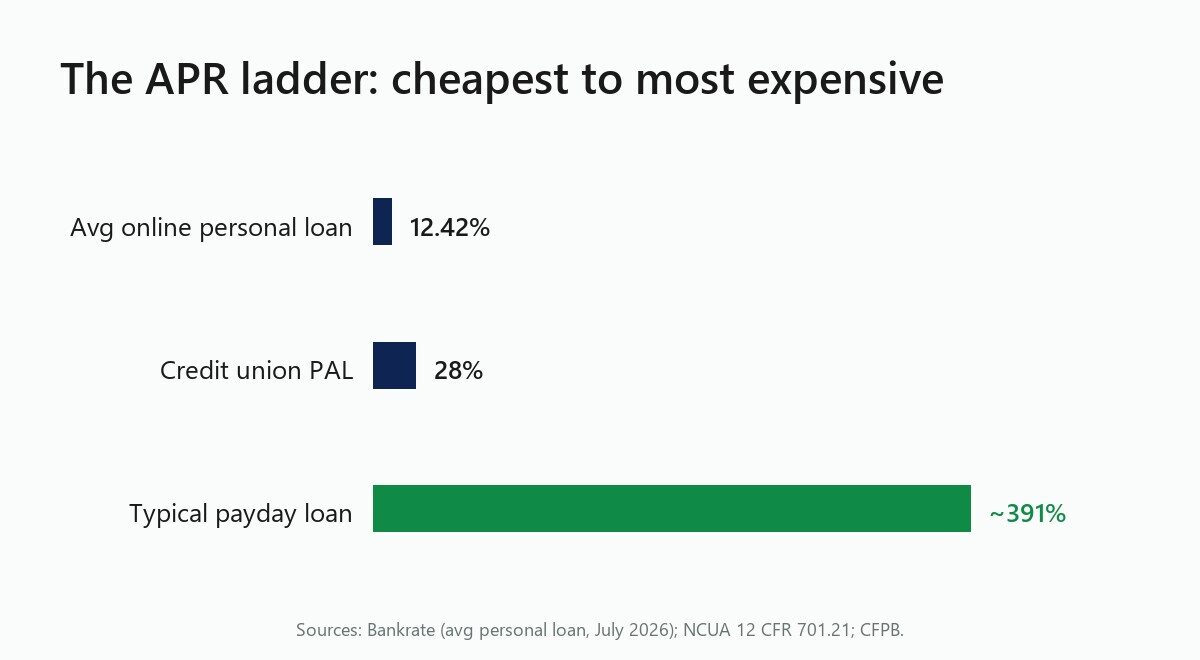
Compare the APR on every offer you prequalified for. It matters more than the approval odds or the payment amount. For scale, the average online personal loan carries roughly a 12.42% APR for a borrower with a 700 FICO score as of July 2026, according to Bankrate's rate tracking. Anything you are offered that runs far above that number needs a hard look at what that APR actually costs you in real dollars before you sign anything.
Where you get a short-term loan changes that math more than most borrowers expect. An online installment lender, a credit union, and a storefront payday shop sit at genuinely different points on the cost scale, even when their marketing sounds similar. The only way to know where a specific offer lands is to read its APR next to the others you prequalified for, side by side.
Step 4: Verify the Lender and Read the Agreement Before You Sign
Before you hand over a Social Security number and bank routing details, confirm the lender is actually licensed to operate in your state. NMLS Consumer Access is the free lookup tool the Consumer Financial Protection Bureau points consumers toward for checking whether a financial-services company is authorized to do business where you live. A legitimate lender hands over its license number without hesitation. One that dodges the question is telling you something.
Identity verification at this stage usually means uploading a photo of your ID and connecting your bank account, either through a read-only link or a pair of small deposits you confirm back to the lender. That part is normal. A lender asking for an upfront fee before releasing funds, refusing to list a physical business address, or pressuring you to sign the same day with no time to actually read the terms is not. Any one of those is a reason to stop and look elsewhere.
Once you have picked an offer, read the agreement before you click accept. The document should confirm the same APR, finance charge, and repayment schedule you saw at prequalification. A full line-by-line walkthrough of exactly what to check before you sign will catch what a quick skim misses, and that beats finding out what you overlooked after the money is already gone.
Common Reasons an Application Gets Denied After You Prequalify
Getting a strong rate at prequalification does not guarantee final approval. A handful of things commonly derail an application between the soft pull and the funded loan, and knowing them ahead of time saves you a wasted afternoon.
- Verified income comes in lower than what you estimated on the prequalification form
- Recent overdrafts or a run of negative bank account days show up during income verification
- The bank account you listed has been open too short a time for the lender to see a deposit pattern
- Your debt-to-income picture changes once the lender counts other short-term loans you already carry
None of these are permanent. A denial at this stage usually means fixing the specific issue, whether that is letting an account season longer or paying down another balance, then reapplying or trying a lender whose underwriting fits your situation better.
Step 5: Funding and What Happens Next
Most online short-term lenders fund within roughly one to three business days of approval, typically by direct deposit through ACH. Same-day funding is sometimes available for smaller loan amounts if your identity and income verification wrap up before the lender's daily cutoff, which commonly falls in the early-to-mid afternoon. A same-day wire transfer can land faster than ACH, but it usually carries a fee that ACH does not. Check that the deposited amount matches what you were quoted before you spend a cent of it.
Once the money lands, check your first payment date against your next payday. Lenders set their own repayment calendar, and it does not automatically match when you actually get paid. Set a reminder a few days ahead of that date.
A short-term loan paid on schedule is a tool. One that gets missed and rolled into a new agreement is how a manageable bill turns into a longer problem.
What to Do If You Cannot Make a Payment
Call your lender while the payment is still upcoming. Reaching out early is the version of this conversation that actually goes in your favor. Ask directly whether they offer a hardship extension or a revised schedule.
Be careful with rollovers. Extending a loan by rolling it into a new agreement usually adds a fresh round of fees on top of what you already owe, turning a short-term loan into a longer and pricier one. If a lender's only answer to a missed payment is rolling it over, ask what that does to the total cost before you agree to anything.
Frequently Asked Questions
No. Prequalifying uses a soft credit inquiry, and the Consumer Financial Protection Bureau confirms that soft pulls do not affect your credit scores. You can prequalify with several lenders at once to compare offers without any risk. Only formally applying and accepting a loan triggers a hard inquiry.
Most online short-term lenders fund within one to three business days after approval, usually by direct deposit. Same-day funding is possible for smaller amounts if verification finishes before the lender's daily cutoff. Same-day wire transfers can be faster than ACH, though they typically carry an extra fee.
Use NMLS Consumer Access, the free lookup the Consumer Financial Protection Bureau points consumers toward for checking whether a financial-services company is authorized to operate in your state. Ask the lender for its license number directly, too. One that dodges the question or won't name its state registration is a red flag worth walking away from.
Usually, yes. The NCUA's PAL rule, 12 CFR 701.21, caps credit union Payday Alternative Loans at 28% APR, well below what many online short-term loans charge. You typically need to already be a member, or join, at a participating credit union, so check your eligibility there before assuming the option is off the table.
Checking eligibility and prequalifying use a soft credit pull and do not affect your score. Formally applying, meaning you submit full documentation for final approval, triggers a hard pull. Doing your comparison shopping during prequalification keeps your credit report clean until you've actually chosen the offer you want.
Confirm the APR, total finance charge, and full repayment schedule match what you were quoted at prequalification. Federal disclosure rules require lenders to spell these out clearly. Read every line before you sign, and remember that a signed short-term loan agreement is a binding contract the moment you accept it.