
You've heard the advice already. Bad credit, need cash, go to a credit union. Somebody's cousin said it. A forum thread said it.
Maybe your bank's own decline letter hinted at it. Fine.
But "go to a credit union" is a rumor with a decent kernel of truth buried inside, and a rumor doesn't tell you what to ask for at the counter. Walk into a branch and request "a bad credit personal loan" and the loan officer is going to ask you a follow-up question, because a credit union usually has three or four products that could fit you. One of them isn't even called a loan on the paperwork.
A credit union loan officer looks at more than your credit score, and asking for the wrong product by name just gets you sent back for a second trip. Most people who show up already know one credit union product by name: the Payday Alternative Loan, capped at 28% APR and built specifically to undercut storefront payday shops. It's a real option and it works.
This site already covers the NCUA's Payday Alternative Loan program in full, so I won't re-walk that ground here. What I want to cover is everything else sitting on the same shelf, because most of what makes a credit union worth your time for bad credit never gets mentioned in the same breath as PALs.
Say your car needs a repair before Monday, or rent is due and payday landed short. That's the kind of scenario credit unions are built to handle, and the credit union three blocks from you usually has more than one way to solve it.
Unsecured Personal Loans: Softer Underwriting Than a Bank
A credit union's plain, ordinary unsecured personal loan is the same loan every member applies for, whether their credit is excellent or bruised. The difference is who's reading your application. A community bank loan committee often leans hard on your FICO score and moves on to the next file.
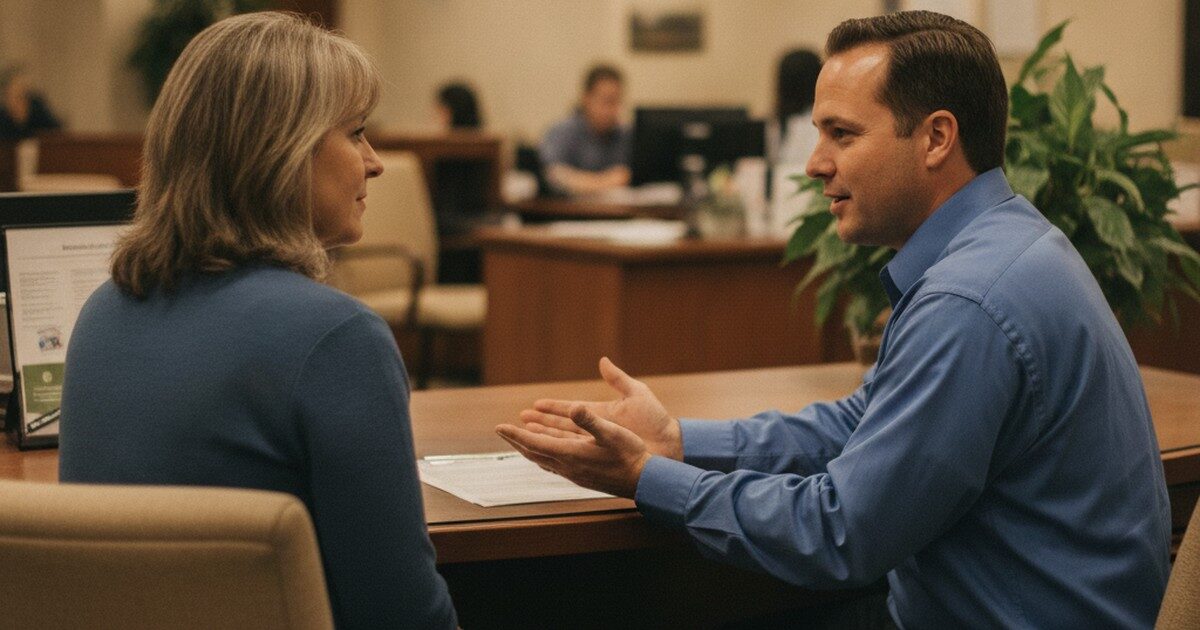
A credit union loan officer reads the whole file: how long you've banked there, whether your direct deposit lands on time, whether you've got a savings habit even a thin one. A member-owned institution can use that kind of discretion because its structure allows it.
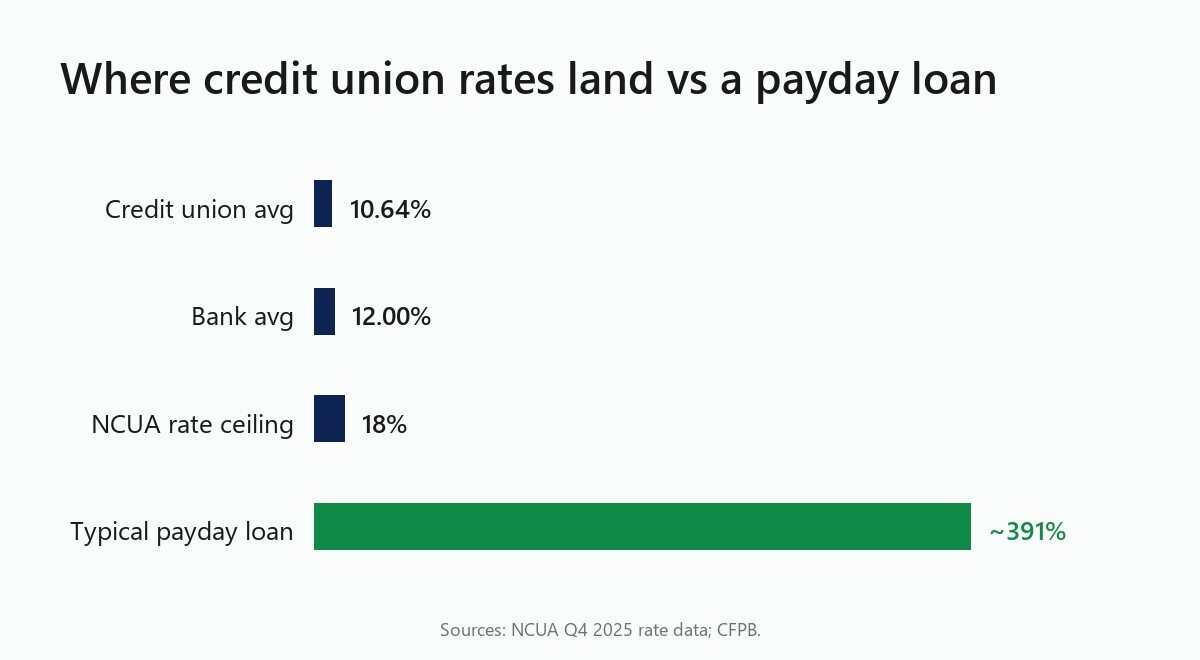
The pricing backs this up. In the fourth quarter of 2025, federal credit unions averaged 10.64% APR on 36-month unsecured personal loans, while banks averaged 12.00% on the same product, an apples-to-apples number pulled from the NCUA's own published table of credit union and bank rates. Federally chartered credit unions also can't legally charge more than the NCUA's rate ceiling on most loans, currently 18% APR and extended through September 10, 2027.
That 18% figure is a hard ceiling, not a typical rate. Actual averages, as you just saw, run well under it. One caveat worth knowing before you assume it applies everywhere: state-chartered credit unions follow their own state's usury limits instead of this federal ceiling, so ask which kind you're dealing with before you count on that cap.
Who fits here? Someone with a bruised score but a steady income and an existing relationship with the credit union, even a short one. If you already bank there and your deposits land on a consistent schedule, you have a better shot at this than at a bank across town that's never seen you before.
Credit Builder and Second-Chance Loans: Pay First, Build Credit Second
This is the product almost nobody outside a credit union has heard of, and it's built for exactly you if you're thin-filed or rebuilding. A credit builder loan, sometimes called a second-chance loan, flips the order most people expect: the credit union puts the loan amount into a locked savings account in your name before you ever touch a lump sum.
You make fixed monthly payments against that locked account, and once it's paid off, the money releases to you. You're paying yourself back, on a schedule that reports to the credit bureaus every month.
The results are backed by real numbers. The CFPB studied 1,531 credit union members who were offered credit builder loans and found that borrowers with no existing debt saw their scores rise about 60 points more than similar borrowers who didn't get one. Credit-invisible participants were 24% more likely to have an established credit score afterward.
That study is from 2020, the CFPB's foundational research on the product, and the results still hold up as the best evidence we have.
Two products get mixed up here, and they solve different problems: a credit builder loan and a share-secured loan are not interchangeable. A credit builder loan is for someone who doesn't have savings yet to pledge. It's a starting point for someone building history from scratch, and it's the product to ask for by name if you're rebuilding a thin credit file. Some credit unions will also check what's called alternative credit data, the rent and utility payment history that shows up when a traditional score can't, and a credit builder loan is exactly the kind of record that data can capture.
Think of it as building payment history early, well before an emergency forces the issue. A member who starts a credit builder loan today has real, reported progress by the time a bigger request comes up.
Share-Secured Loans: Borrowing Against Money You Already Have
This is the one to ask about if you already have some savings sitting in a credit union account and want a fast, low-friction way to build credit on top of it. A share-secured loan, sometimes called a savings-secured loan, uses your own share account (a credit union's word for a savings account) as collateral. The credit union freezes that balance, hands you a loan against it, and reports your payments to the bureaus like any other installment loan. Miss payments and the credit union can claim the frozen savings to cover it, so the risk to the lender is close to zero.

Because the credit union is barely taking on any risk, the rate is typically pegged just a few points above whatever your own savings account is already earning, which normally makes it the cheapest loan a credit union offers. I won't give you a specific number here. Rates vary too much by institution and by what your savings are earning that month to publish one figure and have it mean anything. Ask your loan officer what the current margin is over your savings rate before you sign.
Who fits here? Someone with existing savings parked in a share account who wants a credit-building win without touching that money directly, or who wants to establish a payment history fast ahead of a bigger loan application down the road. It's also one of the lowest-risk ways to rebuild after a rough patch, since your own money is backstopping the whole thing. That money stays protected while it's doing the work: NCUA share insurance covers member deposits, checking and savings alike, up to $250,000 per member, per federally insured credit union, automatically, the moment you join.
How Credit Union Membership Actually Works
Before any of the above applies to you, you have to actually get in the door, and this is the part every listicle skips. A credit union is a member-owned cooperative, and legally, it can't just let anyone open an account. Every credit union operates under a "field of membership," a defined group of people it's chartered to serve.
The NCUA recognizes three types: single common bond (you work for one specific employer or belong to one occupation), multiple common bond (you fall under one of several qualifying groups), and community charter (you live, work, worship, or attend school in a defined geographic area). Knowing which type a specific credit union operates under saves you a wasted trip.
This is why you can get turned away from one credit union and approved at the one down the street. That's usually a charter decision at work, not a reflection of your credit. The good news: community charters are common, and many are open to anyone who lives or works inside a defined area, plus others you can join through a qualifying association for a small fee.
If a credit union tells you that you don't qualify, ask what associations or employer groups would get you in, before you walk away assuming credit unions aren't for you. That single question fixes more rejections than people realize.
Joining itself is fast and cheap where it applies, often finished the same day and often entirely online. Most credit unions require a small share deposit, commonly somewhere in the $5 to $25 range. It's refundable, and it counts as your first bit of ownership in the cooperative. Some let you open that share account and apply for a loan in the same visit, occasionally the same online session.
Others require a small one-time donation to a partner nonprofit if that's how they satisfy your field of membership. None of this is set by federal rule. Every credit union sets its own minimum, so ask what yours charges. Don't assume the number from some other institution applies to you.
While you're opening that share account, it's worth a look at your everyday checking account too, since the right one can save you real money over a year.
What to Ask Your Loan Officer for, by Name
Walking into a branch armed with the right vocabulary changes the conversation. Loan officers respond to specifics. Here's what to actually say:
- "I'd like to apply for an unsecured personal loan and I want you to look at more than my credit score." This signals you know the underwriting is broader here and invites the officer to pull in your account history.
- "Do you offer a credit builder loan or second-chance loan?" Use both terms since credit unions name this product differently.
- "I have savings with you. Can I get a share-secured loan against it?" Specify the account if you have more than one.
- "What's my field of membership here, and is there an association I could join if I don't currently qualify?"
- "What's the share deposit or membership fee, and is it refundable?"
- "Do you also offer a Payday Alternative Loan, and how does its rate compare to what you just quoted me?"
Bring pay stubs, a government ID, and proof of address. If you already have a banking history anywhere, bring recent statements too. That paper trail is often worth more at a credit union than the number on your credit report, since the officer reading it can weigh your whole financial picture alongside the score. Handing over that documentation up front, without being asked twice, is its own small signal that you're someone worth taking a chance on.
The CFPB puts a typical storefront payday loan at about $15 per $100 borrowed for two weeks, which works out to roughly 391% APR. Set that next to a credit union rate sitting under 18%, and the gap is hard to ignore. That's worth remembering the next time a payday sign looks like the fastest option in the parking lot.
Frequently Asked Questions
It depends on the credit union and which product you request. Unsecured loans weigh your full account history alongside your score, so approval is possible even with a rough score. A share-secured loan or credit builder loan removes most of the credit-score barrier entirely, since collateral or a savings-first structure backs the risk.
Yes. Credit unions are member-owned, so opening a share account (their term for a savings account) makes you a member and is required before any loan closes. Many credit unions let you open that account and submit your loan application in the same visit or session.
A credit builder loan is for someone without savings to pledge: the credit union locks the loan amount in an account as you pay it off. A share-secured loan borrows against savings you already have. Both report to the bureaus, but they solve different starting problems.
Most credit unions require a small, typically refundable share deposit, commonly in the $5 to $25 range, since that deposit represents your ownership stake. Some credit unions instead require a one-time donation to a partner nonprofit to satisfy field of membership rules. The exact amount varies by institution, so ask directly.
Ask anyway. Community charters are common, and many credit unions offer one that's open to anyone in a defined area, or membership through an inexpensive qualifying association. A loan officer can usually tell you on the spot whether you qualify or which association would get you in.