

You have the Check City application open. Before you hit submit you want to know three things: does Check City actually operate legally where you live, what does its own published fee schedule say, and has any regulator ever gone after this company. Most of what gets written about payday lenders online is either a star-rating aggregator or a marketing page, and neither answers those three questions directly. This piece answers all three using Check City's own disclosures alongside regulator and Better Business Bureau records.
A Check City payday loan looks different depending on where you live. What you're offered depends entirely on which state's rate page applies to you, and those pages differ enough that a fee quoted in Nevada tells you almost nothing about what you'd pay in California. Here's what Check City discloses, state by state, plus a worked example of what one of those fees actually costs as an annual percentage rate.
Which States Check City Actually Operates In
Check City states it has operated since 1986 and is based in Provo, Utah, according to Check City's own rates and fees index. That makes it a four-decade-old company that has grown from that Utah base into a footprint covering 15 states today. That same index page lists dedicated rates-and-fees pages for those 15 states: Alabama, Alaska, California, Idaho, Kansas, Louisiana, Mississippi, Missouri, Nevada, Ohio, Oklahoma, Texas, Utah, Wisconsin, and Wyoming.
If your state isn't on this list, Check City doesn't have a rates page for you there. Check what's legal in your state before assuming a similar product is available.
Texas deserves its own note, because the structure there is genuinely different. In most of its 15 states, Check City is a direct lender. In Texas, it operates as a credit services organization, also called a credit access business: a third-party lender actually funds your loan, and Check City charges a separate CSO fee for arranging it, according to Check City's own licensing disclosure. That CSO fee comes on top of whatever the funding lender itself charges, which means a Texas borrower is effectively paying two separate parties for one loan.
If you're applying from Texas, you aren't borrowing directly from Check City the way a California applicant would. The paperwork is different, and so is the party actually extending you credit. Before you sign in Texas, look for the name of that separate funding lender on the loan agreement, since that is the entity you are actually contracting with for the money itself.
California's licensing is spelled out on Check City's own site: the company is licensed by the California Department of Financial Protection and Innovation under the California Deferred Deposit Transaction Law. Ohio operations run under a specific entity name, CCO Ohio, Inc., doing business as CheckCity.com.
No specific NMLS ID number for Check City or its state-level entities turned up. The company's licensing page names its DFPI license and Ohio dba, but no NMLS number appears on it. If you want to confirm licensing in your own state before signing, the tool for that is the NMLS Consumer Access database, where you can look up a lender by name and state on your own. It's a free public lookup, and it's a faster way to confirm licensure than calling a branch and asking.
What Check City's Own Fee Pages Actually Say
Fee structures vary by state statute, which is exactly why you should read the page for your own state. Here's what's confirmed from Check City's own published pages for the states with fully verified figures.
California
Check City's California rates page states the fee as $17.65 per $100 borrowed, though the page text shows this figure inconsistently, once as $17.65 and once as $17.64. Take that inconsistency as a reason to read your own disclosure line by line. The page also lists a maximum loan amount of $255, a maximum term of 31 days, and a non-sufficient-funds fee of $15. That $15 is separate from the per-$100 fee: it's what Check City states it can charge if your payment bounces.
Nevada
Nevada's rates page states the fee as $8.25 per $100 per week, with a loan term running a minimum of 4 days and a maximum of 35 days. Nevada doesn't use a flat dollar cap the way California does. The page states your maximum loan amount cannot exceed 25 percent of your gross monthly income and is set individually per applicant.
Because the page states $8.25 per $100 per week, the total cost scales with how long you carry the loan. Carried the full 35 days, that is 5 weeks times $8.25, or $41.25 per $100 borrowed. That per-week structure means paying the loan off sooner than the 35-day maximum lowers the total fee, since each additional week adds another $8.25 per $100.
Utah
Utah's page confirms a minimum loan of $50, with loan limits otherwise set individually based on income, and a term running a minimum of 4 days to a maximum of 36 days. Total loan term including extensions cannot exceed 70 days, and extensions are prorated based on the number of days extended, per Check City's Utah rates page. That 70-day ceiling means an initial 36-day loan can be extended, but not indefinitely, and the prorated structure means a short extension should cost less than a full second term.
The exact fee-per-$100 figure for Utah is not published in readable text on that page, only inside an "Example APR and Fee Schedule" table that renders as an unreadable image, so no Utah dollar figure appears here. If you're borrowing in Utah, ask Check City directly for the exact fee in writing before you sign anything, and keep that written answer for your own records.
The other 12 states
Alabama, Alaska, Idaho, Kansas, Louisiana, Mississippi, Missouri, Ohio, Oklahoma, Texas, Wisconsin, and Wyoming each have their own dedicated rates page on Check City's site, confirmed to exist, but their individual fee numbers weren't pulled. State statutes set those fee caps and vary considerably, so a California number tells you nothing reliable about what Ohio or Wyoming charges, and the same loan structure can carry a very different price tag depending on where you sign. If you're applying from one of these states, pull up your own state's page on checkcity.com and read the fee line before you agree to anything.
What the California Fee Actually Costs as an APR
Check City's Nevada and Utah pages reference an "Example APR and Fee Schedule" table, but it renders as an unreadable image on the site, so no APR percentage could be confirmed from either page. Take California's own disclosed terms: a $255 loan, the maximum the state allows, at $17.65 per $100 borrowed.
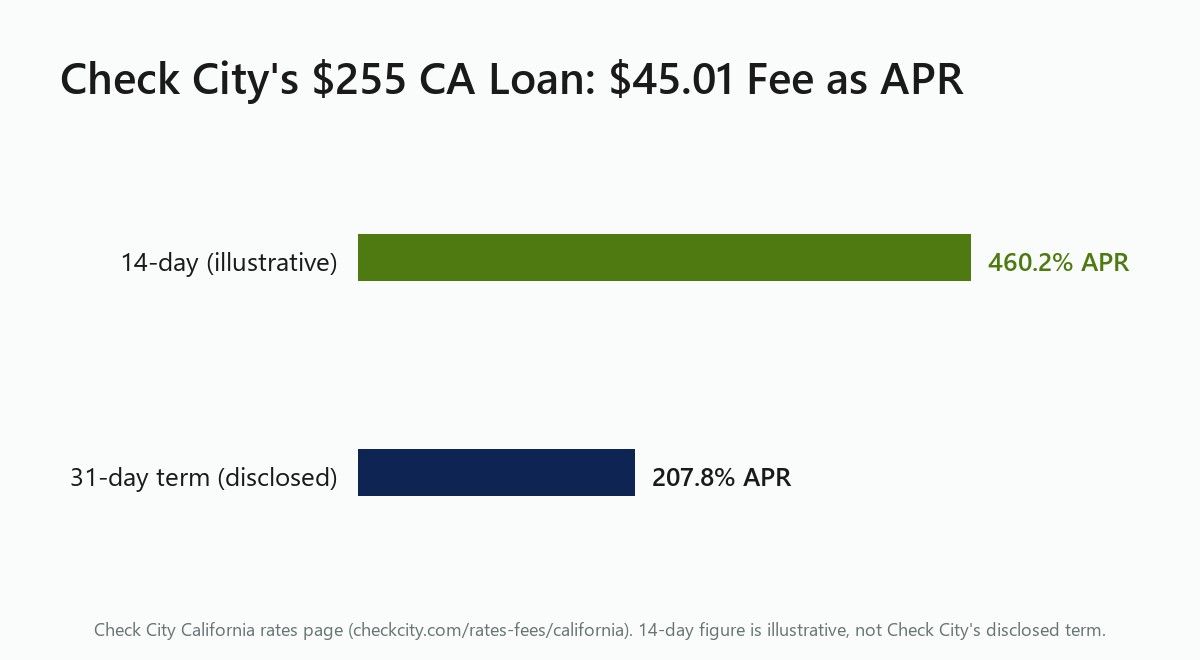
2.55 times $17.65 comes to $45.0075, which rounds to a $45.01 fee. Applied across California's stated maximum 31-day term, using the standard formula of APR equals fee divided by principal, times 365 divided by term days, times 100, that works out to roughly 207.8 percent. That math assumes the flat $45.01 fee applies at the full 31-day term, an assumption Check City's page doesn't explicitly confirm for this loan size. The page also doesn't specify a minimum term for California, so a shorter common payday term like 14 days can't be confirmed as the actual structure for this loan.
But it's worth seeing anyway: the same $45.01 flat fee applied to a 14-day term produces an illustrative APR of roughly 460.2 percent. That figure is illustrative only. It shows how sharply the same dollar fee reads once you compress the repayment window. Check City does not disclose this shorter term as its actual product for California.
Read that gap again. A $45.01 fee on a $255 loan sounds almost reasonable stated as a flat dollar amount. Stated as an annualized rate, it runs well past 200 percent. That gap is exactly why a small dollar fee can still mean a scary APR.
Regulatory History
Before signing with any lender, it's reasonable to ask whether regulators have ever acted against it. No CFPB enforcement action against Check City turned up. A specific search for CFPB action tied to the company surfaced only an unrelated case: the CFPB's case against All American Check Cashing and Mid-State Finance, a different company sued over deceptive check-cashing disclosures, with litigation that reached the Fifth Circuit.
That case has nothing to do with Check City and shouldn't be confused with it based on the similar name.
No state attorney general lawsuit, settlement, or consent order naming Check City turned up either. Searches surfaced AG and city-attorney actions against other, differently named payday lenders, but nothing naming Check City itself.
It's worth being precise about what that absence means. This research found no enforcement action against Check City within the searches run on September 24, 2026. That is not the same as a clean bill of health from a regulator, and it's not the same as a comprehensive legal-database search. It means nothing turned up.
If regulatory history matters to your decision, you can search your own state attorney general's consumer protection page and the CFPB's consumer complaint database directly before you sign. Both are free to search by lender name, and neither requires you to create an account or submit any of your own information just to look something up.
Check City's Las Vegas listing on the Better Business Bureau shows an A+ rating, BBB Accredited Business status, and 7 complaints closed in the prior three years. The specific content of those 7 complaints wasn't accessible, only the aggregate count, so there's no way to say what borrowers were complaining about, only that the count exists. It's also worth remembering that BBB accreditation reflects standing with a private, nonprofit business organization. State regulators are the separate authority that determines whether a lender's rates and practices are legal in your state.
Before You Sign
Pull up the specific rate page for your own state and check the fee line, the term, and any extension terms against what the application in front of you shows. If anything on the signing screen doesn't match what Check City's own rates page says for your state, that's worth a phone call before a signature. A mismatch between the disclosed fee and the screen in front of you is the single clearest signal that something needs a second look before you commit.
Before you submit that application, run through this short list:
- Does the fee on the screen match the per-$100 figure published on your state's rate page?
- Does the loan term and maximum amount match what that same page states?
- If you're in Texas, does the paperwork name the third-party lender actually extending credit, separate from Check City's own role?
- Does the licensed entity name on the agreement match what Check City discloses for your state?
For a line-by-line walkthrough of what to check in the agreement itself, read the loan agreement before you sign.
Frequently Asked Questions
No. Check City's own rates-and-fees index lists dedicated pages for 15 states: Alabama, Alaska, California, Idaho, Kansas, Louisiana, Mississippi, Missouri, Nevada, Ohio, Oklahoma, Texas, Utah, Wisconsin, and Wyoming. If your state isn't listed, Check City doesn't publish a rate page for it.
Not in Texas. There, Check City operates as a credit services organization (credit access business): it arranges the loan, but a third-party lender actually funds it. That's a different structure from most of its other states, where Check City lends directly.
Check City discloses a per-$100 fee; it does not publish an APR figure. On California's $255 loan and $17.65-per-$100 fee, that's a $45.01 charge, roughly 207.8 percent APR over the 31-day maximum term. A 14-day term produces an illustrative 460.2 percent, a figure Check City doesn't actually disclose.
No CFPB or state attorney general enforcement action against Check City turned up in searches run on September 24, 2026. That wasn't an exhaustive review of every legal database, so treat it as what those searches found, nothing more.
Check City states it is licensed by California's Department of Financial Protection and Innovation under the California Deferred Deposit Transaction Law, and its Ohio operations run under the entity name CCO Ohio, Inc., dba CheckCity.com. No NMLS ID number was found; look up your own state's licensing at NMLS Consumer Access.
The California rate page states a fee of $17.65 per $100 borrowed, a maximum loan amount of $255, a maximum term of 31 days, and a $15 non-sufficient-funds fee. On the maximum loan and term, that comes to a $45.01 fee.