


A TD Fit Loan carries a fixed rate between 7.99% and 23.99% APR on amounts from $2,000 to $50,000, with no origination fee, no application fee, and no prepayment penalty, according to TD's Fit Loan product page. That single data point explains why "TD Fit Loan" pulls thousands of monthly searches from people looking to cover a shortfall without turning to a payday lender. Before you apply for anything, you need to know what this loan actually costs against the two products most people reach for: a credit card cash advance and a payday loan.
This piece walks through TD's own published terms first, then works the arithmetic on a realistic $2,000 shortfall so you can see the dollar difference for yourself, line by line.
What a TD Fit Loan Actually Costs: Rates, Terms, and Fees
The TD Fit Loan is TD Bank's unsecured personal loan product, and its structure is simpler than most short-term borrowing options. TD lends between $2,000 and $50,000 at a fixed APR ranging from 7.99% to 23.99%, with terms running 36 to 60 months, according to TD's product page. The rate stays fixed for the life of the loan, which means your payment in month one matches your payment in month 36.
TD does not charge an origination fee, an application fee, or a prepayment penalty. If you do end up late, the fee structure is capped: 5% of your minimum payment or $10, whichever is less, and only after a 16-day grace period, per TD's Fit Loan application FAQ. Florida residents should expect a state-mandated documentary stamp fee on the loan contract. That amount varies by contract, so check your own loan disclosure for the exact figure before you sign.
Third-party reviews also commonly describe the Fit Loan as unavailable for business or education expenses, though TD's own consumer-facing pages don't spell that restriction out word for word.
TD's rate-check step uses a soft credit inquiry, which does not affect your credit score. A hard inquiry only happens if you move forward with the full application. That sequencing matters for anyone shopping rates before committing: you can see what TD is likely to offer without a mark on your credit file, then decide whether to formally apply once you know the number.
Funding moves fast by bank standards: TD's stated goal is same-day processing, and funds typically reach your receiving bank within one business day of approval, though your bank may take one to three additional business days to post them to your account, per TD's FAQ. For a reader staring at a surprise bill with a due date attached, that window, same-day approval, next-business-day transfer, a few more days to post, is the practical timeline to plan around.
Who Qualifies for a TD Bank Personal Loan
TD evaluates Fit Loan applicants on four factors: credit score, the relationship between your income and your existing debt payments, your credit experience, and your repayment history, per TD's FAQ. Geographic availability matters too. TD only originates the Fit Loan in 15 states and Washington, D.C.: Connecticut, New Jersey, Delaware, New York, North Carolina, Florida, Pennsylvania, Maine, Rhode Island, Maryland, South Carolina, Massachusetts, Vermont, New Hampshire, and Virginia, per TD's product page. If you live outside that footprint, this product simply is not on the table, regardless of your credit profile.
One common misconception is worth correcting directly: you do not need an existing TD Bank account to get a TD Fit Loan. TD's own application FAQ states plainly that you are not required to open or have a TD bank account to be eligible. TD markets the loan to its own banking customers, and having an existing TD relationship may make the funding step smoother, since you already have a receiving account on file.
But underwriting itself runs on credit and income data. Expect an identity-verification step during the application, and budget time for it.
It's also worth weighing TD's broader track record with consumer credit data before you sign anything. In September 2024, the CFPB ordered TD Bank, N.A. to pay $7.76 million in consumer redress and a $20 million civil penalty for furnishing inaccurate information to credit reporting agencies and failing to properly investigate disputes, affecting more than 50,000 customers, according to the CFPB's September 2024 enforcement action against TD Bank. That action concerned how TD reported and disputed credit data broadly rather than the pricing or terms of the Fit Loan itself, and it remains relevant context for how the bank handles the credit information tied to any account you open with it, given that a personal loan appears on your credit report.
The CFPB's complaint database also logged 55 personal-loan-related complaints against TD Bank in 2024, with unexpected fees and difficulty making payments among the recurring themes, according to a summary published in a 2026 U.S. News review of the lender.
On the regulatory side, TD Bank, N.A. is chartered and supervised by the Office of the Comptroller of the Currency, which puts it under federal bank oversight, a different regulatory track than the state-by-state licensing that governs storefront payday lenders. Truth in Lending Act disclosures, administered through Regulation Z, require lenders and card issuers alike to spell out the APR and fee terms on a product before a borrower is bound by it, the same general disclosure framework that applies to both the Fit Loan and any card you'd use for a cash advance instead.
What $2,000 Actually Costs: TD Fit Loan vs. Cash Advance vs. Payday Loan
Here is the math a bank product page will never run for you: what does covering a $2,000 shortfall actually cost across the three products a paycheck-to-paycheck borrower typically considers? TD's minimum term on the Fit Loan is 36 months, so that timeframe anchors the installment comparison below, giving you a real dollar-for-dollar view of what each product charges to resolve the same need. Every figure below is an illustrative calculation built from each product's own published rate or fee structure, not a quote pulled from any lender, and you can recompute any of them yourself with a standard amortization formula.
TD Fit Loan on $2,000 over 36 months
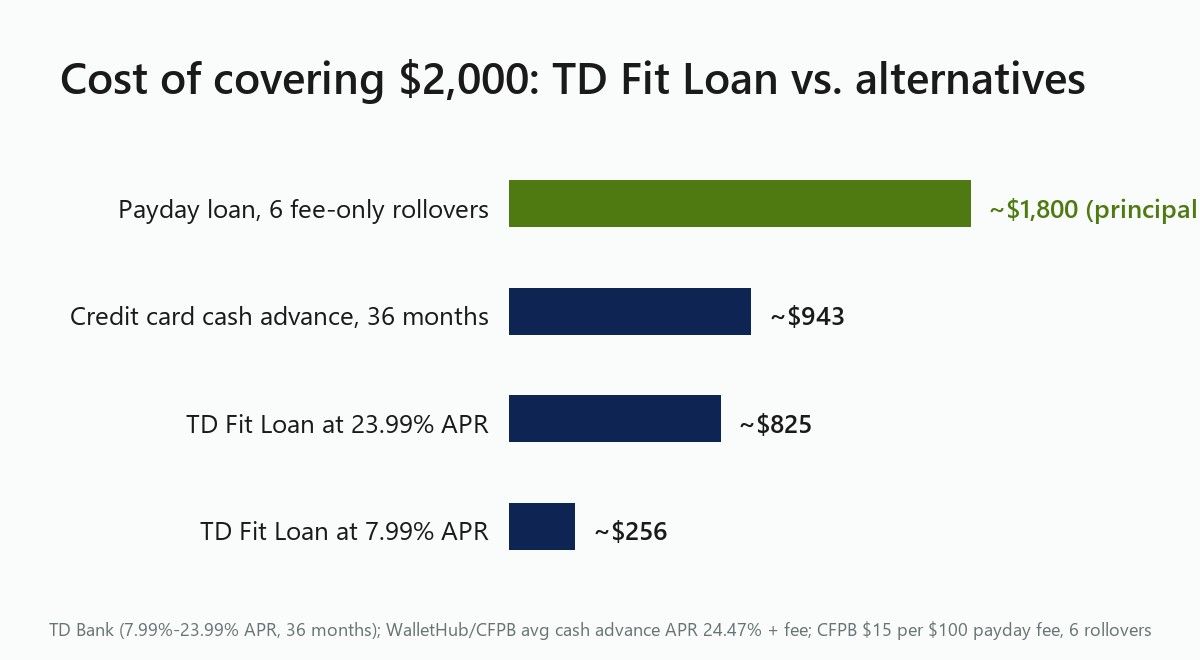
At TD's published 7.99% APR, a $2,000 Fit Loan works out to a monthly payment of about $62.67 and a total repayment near $2,256, putting the interest cost at approximately $256 over the life of the loan. At the top of TD's published range, 23.99% APR, the same $2,000 loan works out to about $78.47 a month, with total repayment near $2,825 and interest cost around $825. Either way, there's no origination fee and no prepayment penalty layered on top.
Credit card cash advance on $2,000 over 36 months
A $2,000 cash advance carries an upfront fee, typically 3% to 5% of the amount withdrawn, with interest accruing immediately since cash advances get no grace period the way purchases do, according to card issuer disclosures and CFPB guidance on credit card terms. At a 5% fee, that's $100 charged the moment you withdraw the cash. Layer on the average cash advance APR of 24.47%, per WalletHub's analysis of CFPB Terms of Credit Card Plans Survey data (August 2026 figure), and this article's own amortization over the same 36 months works out to a payment of about $78.96 a month, total interest near $843, for a combined cost of roughly $943 once you add the upfront fee to the interest.
That total assumes a fixed payoff schedule, the same discipline the TD Fit Loan comparison assumes. Make only minimum payments, and the real cost climbs further, because more of the balance sits at 24.47% for longer, with interest compounding on interest that never had a grace period to begin with. The CFPB's Regulation Z payment-allocation rule (12 CFR 1026.53) does work in your favor here: it requires card issuers to apply any payment above your minimum to whichever balance carries the highest APR first, which in practice often means a cash advance balance gets paid down ahead of a lower-rate purchase balance on the same card.
Payday loan on $2,000, modeled as rolled borrowing
No single storefront payday lender offers a $2,000 loan; the CFPB's 2013 payday loan factsheet puts the average payday loan closer to $375. This figure models what the CFPB describes as typical payday use, repeated two-week borrowing, applied here to a $2,000 shortfall so the comparison lines up with the other two products. At a $15-per-$100 fee, a single two-week cycle on $2,000 costs $300 in fees, which the CFPB calculates as equivalent to an APR of almost 400%, according to the CFPB's payday loan explainer.
Roll that same $2,000 for six consecutive two-week cycles, about three months, following the CFPB's description of typical fee-only rollovers with principal left untouched, and this article's own model puts the fees alone at roughly $1,800. At the end of those three months, you still owe the full $2,000 principal, meaning the $1,800 bought you nothing but time.
Lined up side by side, the TD Fit Loan's interest cost, roughly $256 to $825 depending on your rate, comes in well below the cash advance's combined cost of about $943, which is itself a fraction of the roughly $1,800 in fees a rolled payday loan generates while leaving the principal untouched. For a credit-qualified borrower inside TD's footprint, the Fit Loan functions as a genuine payday loan alternative: it resolves the same $2,000 need at a fraction of the cost, with one fixed payment you can plan around.
When the TD Fit Loan Wins, and When It Doesn't
The math above only holds if you can actually get approved, and that's where the TD Fit Loan narrows sharply compared with payday lending or a cash advance on a card you already hold. TD underwrites this loan on the same four factors covered above: credit score, income relative to debt payments, credit experience, and repayment history. A thin credit file or a recent stretch of missed payments can knock you out of consideration entirely, a bar a cash advance on a card you already hold does not require.
Geography is the other hard constraint. If you live outside TD's 15-state and D.C. footprint, none of this applies to you, however strong your credit looks on paper. And if your credit profile falls short of what a bank-rate installment loan requires, a payday loan or cash advance may end up being your only near-term option, even though the math above shows how much more they cost.
If You Don't Qualify: Where to Go Next
If TD's footprint or underwriting rules you out, you still have options worth pricing before you touch a payday lender. Credit unions offer Payday Alternative Loans capped well below typical payday rates, a structure this site has broken down in "The 28% Loan Most Payday Borrowers Have Never Heard Of". If your credit file is thinner than TD wants but you still need close to $2,000, see "$2,000 Loan With Bad Credit: What It Really Costs" for a comparable worked-example breakdown at bad-credit rates.
If your gap is smaller and the card in your wallet already carries a promotional offer, check "0% Balance Transfer vs Payday Loan: When the Card Actually Wins" before defaulting to a cash advance. And if the amount you need is closer to a few hundred dollars than a few thousand, "Cash Advance App or Eat the Overdraft? The Surprising Answer Depends on the Amount" walks through the smaller-dollar math, since the payday-versus-alternative math changes shape at that size. None of these alternatives carry the Fit Loan's rock-bottom rate ceiling, but each one still beats a two-week payday cycle on total dollar cost.
Bottom Line
The numbers above make the case on their own: a TD Fit Loan is the cheaper way to cover a $2,000 shortfall if you're inside TD's 15-state and D.C. footprint and your credit clears a bank's underwriting bar. If either condition rules you out, price the credit union and bad-credit alternatives above before a payday storefront or a cash advance becomes your default.
Whichever product you land on, run the interest-cost math the way this article just did before you sign anything. Judge a loan by its total dollar cost over the full term; that number is what comes out of your paycheck.
Frequently Asked Questions
No. TD's own application FAQ states you are not required to open or have a TD bank account to be eligible for a TD Fit Loan. TD does market the product to its existing banking customers, and having a TD account on file may smooth the funding step, but it is not an underwriting requirement.
TD discloses that approval is based on four factors weighed together: your credit score, the relationship between your income and your existing debt payments, your credit experience, and your repayment history. You can see where you likely stand before applying, since TD's rate-check step uses a soft inquiry that won't affect your score.
TD's stated goal is same-day processing, with funds typically reaching your receiving bank within one business day of approval. Your own bank may then take one to three business days to post the funds to your account, per TD's FAQ.
Yes, by a wide margin. A $2,000 TD Fit Loan carries an estimated interest cost of $256 to $825 over 36 months. This article's six-cycle model, built on the CFPB's $15-per-$100 payday fee structure, puts the same $2,000 rolled through payday cycles at roughly $1,800 in fees, with the principal still owed at the end.
TD originates the Fit Loan in 15 states and Washington, D.C.: Connecticut, New Jersey, Delaware, New York, North Carolina, Florida, Pennsylvania, Maine, Rhode Island, Maryland, South Carolina, Massachusetts, Vermont, New Hampshire, and Virginia, per TD's product page.