


Apply for a $500 payday loan online, and the number a lender quotes you depends almost entirely on your mailing address. In Florida, that loan runs about $55 in fees. In Missouri, the same $500, borrowed for the same two weeks, can legally cost you $375. Same amount, same 14-day term, a $320 gap in what you owe back.
Use the fee caps and arithmetic below to check a lender's quote against your own state's statute before you apply.
Five states let you get a $500 loan at a defined, capped price. A sixth, California, caps the loan below $500 to begin with. Four don't let you get one at all.
How the Fee Turns Into an APR
Every figure in this article uses the same formula: APR = (fee ÷ cash advanced) × (365 ÷ 14) × 100. That's the standard way to annualize a two-week finance charge, and it's the formula behind every percentage quoted below, whether the underlying fee is a flat percentage, a per-$100 tier, or a statutory ceiling like Missouri's.
If you want the full walkthrough of why a flat-looking $45 fee turns into a rate in the hundreds of percent, quick5k's true-cost APR explainer covers that in detail. Below, the same formula gets applied to ten real fee caps pulled from ten real statutes, so you can see exactly where each state's percentage comes from.
One thing worth flagging up front: every APR below is a 14-day, single-payment figure. None of them include what happens if you renew or roll the loan over. Several of these states allow renewals, and each one adds another round of fees on top of what's already shown here, which is worth remembering before you assume the number below is the worst case.
Missouri is the state where renewals matter most: its 75% fee cap applies across the original loan and up to six renewals combined, not once per renewal, so the total cost is bounded even if the loan gets extended. The Missouri section below shows exactly how that cap works.
What a $500 Online Payday Loan Costs in States That Allow It
These five states let a lender legally originate something close to a $500 payday loan, each with a different fee structure written into state law.
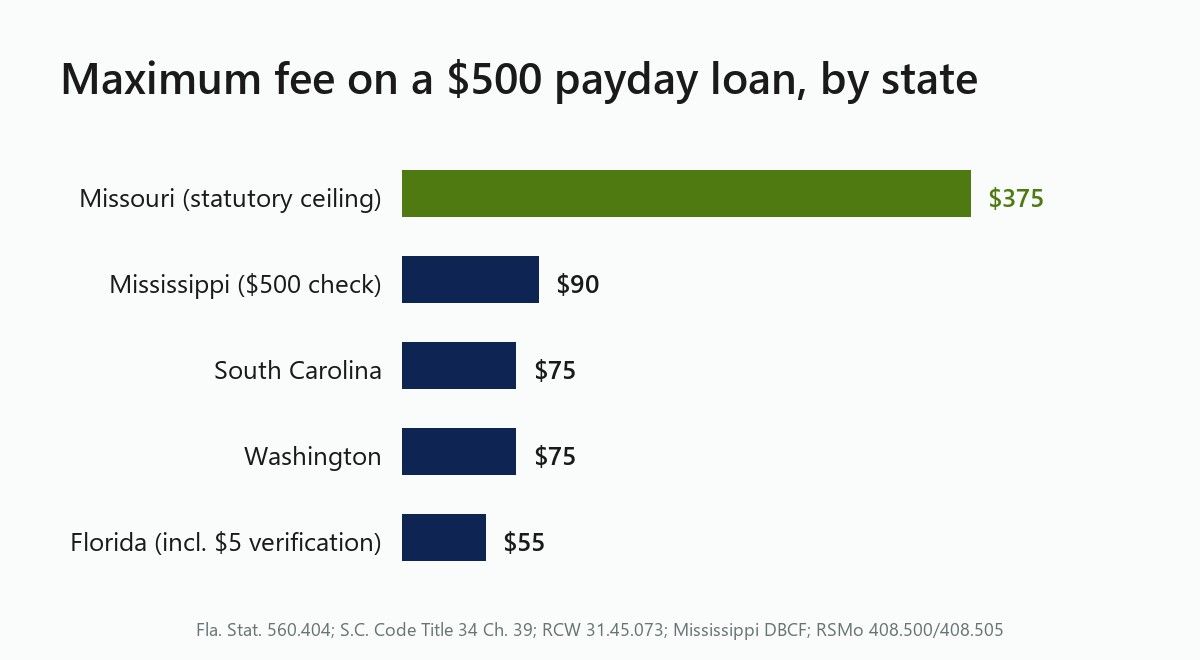
Florida. The maximum loan size is $500, and the fee is capped at 10% of the amount plus up to a $5 verification fee, under Fla. Stat. § 560.404.
On a full $500 loan: $50 (10%) plus $5 verification equals a $55 fee. Run that through the formula: (55 ÷ 500) × (365 ÷ 14) × 100 comes out to roughly 287%. That's the lowest annualized rate of any state checked here, because Florida's 10% fee rate is lower than the 15% used in South Carolina and Washington.
South Carolina. The state's Deferred Presentment Services Act sets a max loan of $550, so a $500 loan fits comfortably under the ceiling, and the fee runs 15% of the amount advanced (S.C. Code Title 34, Ch. 39).
On $500, that's a $75 fee. (75 ÷ 500) × (365 ÷ 14) × 100 works out to about 391%.
Washington. RCW 31.45.073 allows loans up to $700, with a fee tier of $15 per $100 (15%) on amounts up to $500, and 10% on any portion above that. A $500 loan lands entirely in the 15% tier, so the fee is $75, the same dollar amount as South Carolina. The math is identical: (75 ÷ 500) × (365 ÷ 14) × 100 ≈ 391%.
Mississippi. Here's where the headline number and the cash in your pocket split apart. Under the Check Cashers Act, the maximum check a borrower can write is $500, with the fee deducted up front, before any money changes hands. For a check in the $251-$500 range, the fee tier is $21.95 per $100 advanced.
Mississippi's own consumer pamphlet works the example directly: a $500 check produces $410 cash advanced and a $90 fee (Mississippi Department of Banking and Consumer Finance). So when a Mississippi lender advertises a "$500 payday loan," that $500 describes the check you sign, and the amount that actually lands in your account is $410.
The APR calculation uses the real cash advanced, $410, as the base: (90 ÷ 410) × (365 ÷ 14) × 100 ≈ 572%. If you're shopping in Mississippi, read the disclosure line marked "amount financed" carefully, since that's the figure that matches what you'll actually receive.
Missouri. This one works differently from the rest of the fee-capped states above. Missouri doesn't set a flat percentage or a per-$100 fee tier the way Florida, South Carolina, and Washington do. Instead, two sections of the same statute do the work: RSMo § 408.500 sets the $500 threshold at which a lender needs an unsecured-loan license in the first place.
RSMo § 408.505 is the section that actually caps the cost: total interest and fees can't exceed 75% of the loan amount, for the entire term of that loan and all renewals combined. Loans run a minimum of 14 days and a maximum of 31 days, whether original or renewed, and state law allows no more than six renewals on a single loan.
For a single $500 loan held at the statutory minimum term of 14 days and not renewed, the legal ceiling on fees is 75% of $500, or $375. Run that through the formula: (375 ÷ 500) × (365 ÷ 14) × 100 lands at roughly 1,955%.
It's the statutory maximum for the shortest possible term. Lenders may charge less than the ceiling, and a loan held closer to the 31-day maximum annualizes lower, since the same 75% gets spread over more days.
Lined up together, the fee on a fee-capped $500 loan runs from $55 in Florida to $90 in Mississippi to a statutory ceiling of $375 in Missouri, and the resulting 14-day APR spans roughly 287% to a 1,955% statutory maximum, all for a $500 loan (a $500 check, in Mississippi's case).
The State Where a $500 Online Payday Loan Doesn't Exist: California
If you're searching from California, stop and save yourself the application. A single-payment $500 payday loan is not available there at any price.
The California Deferred Deposit Transaction Law caps the check itself at $300, under California Financial Code § 23035, with a fee capped at 15%. At the $300 maximum, that's $255 cash advanced and a $45 fee.
(45 ÷ 255) × (365 ÷ 14) × 100 comes out to about 460%, on the $300 ceiling. Any site advertising a $500 payday loan to a California resident is quoting a loan size the state's own deferred deposit law doesn't permit. If you need more than $255 in California, a single-payment payday loan legally can't get you there, and you'd be looking at a different loan product entirely.
Where a $500 Payday Loan Is Illegal
Four of the states checked here don't have a fee cap to compare, because the product itself isn't legal there. Each one gets to that result through a different legal mechanism: a criminal statute, a general usury cap, or a rate cap written for a broader class of consumer loans. The distinction matters if you're trying to understand your own state's law, not just whether the loan is available.
Georgia makes payday lending a crime outright. O.C.G.A. § 16-17-2 prohibits making, offering, or arranging loans of $3,000 or less outside a chartered financial institution, with violations charged as a high and aggravated misdemeanor that escalates to a felony on repeat offenses. There's no legal fee schedule to quote because there's no legal product.
New York gets there through its usury statutes. General Obligations Law § 5-501 sets a 16% civil usury cap, and Penal Law § 190.40 makes charging above 25% APR criminal usury, a felony. Every rate shown above, 287% up to Missouri's 1,955% ceiling, sits many multiples over both New York thresholds, which is why the product isn't offered there.
North Carolina let its payday-specific authorization sunset in 2001, and never renewed it. The state's general usury cap, G.S. § 24-1.1, sets a 16% ceiling on consumer loans generally, which closes the door on a legal payday-style product.
Illinois deserves a more precise description than "banned," because its mechanism is legally distinct from the other three. The Predatory Loan Prevention Act, 815 ILCS 123, effective March 23, 2021, caps the all-in annual rate at 36% on nearly every consumer loan in the state.
The law isn't a payday-specific prohibition; it sets a 36% rate cap that a 287-to-1,955-percent product can't survive.
If you're in any of these four states, the state-by-state fee comparison above doesn't apply to you, since the product itself isn't on offer legally there. Quick5k's guide to payday loan bans and legal alternatives covers what borrowers in banned states actually use instead, and it's a better next stop than this article for that question.
Check Your Own State Before You Apply
Every figure above is a point-in-time snapshot, verified current as of this writing. State legislatures amend fee caps and loan-size limits regularly, and a rate that's accurate today can shift after the next legislative session, so pull up your own state's statute or your state regulator's consumer page and compare the fee schedule against what the lender is quoting you. The statute links throughout this article are a starting point for that search, and each one reflects whatever the legislature has most recently passed, so confirm the live page before you sign anything.
A few practical checks worth making: confirm the cap structure your state actually uses, ask the lender to show you the exact dollar fee before you agree to the loan, and if a lender's website doesn't reference your state's specific fee cap, treat that as a sign to verify their license with your state's banking or financial regulation department directly. A lender operating legally in your state should be able to point you to the exact statute this article cites for that state, without hesitation and without redirecting you to a vague disclosure page.
When you have the actual loan agreement in front of you, look for three things before you sign: the dollar fee spelled out in writing, the lender's license number for your specific state, and whether the loan can be renewed and what each renewal adds. A specific citation is a good sign; a Missouri lender, for example, should be able to point directly to RSMo § 408.505 for the 75% cap. If a lender can't answer those three questions directly, that's reason enough to keep shopping.
Frequently Asked Questions
It depends on your state. Among the states checked here, the fee on a $500, 14-day loan ranges from $55 in Florida to a statutory ceiling of $375 in Missouri, for a single non-renewed term. South Carolina and Washington both land at $75, and Mississippi charges $90 on $410 cash advanced against a $500 check.
Among the five states checked that allow a $500 or near-$500 loan, the 14-day APR ranges from about 287% in Florida up to a statutory ceiling near 1,955% in Missouri. South Carolina and Washington land near 391%, Mississippi around 572%. California doesn't allow a $500 loan at all; its $300 maximum works out to about 460%.
No. California's Deferred Deposit Transaction Law caps the check at $300, with a maximum of $255 in cash advanced.
A single-payment payday loan at the $500 size isn't legally available in California at any price, regardless of what a lender's ad or landing page suggests.
Among the states checked here, Georgia bans the product through a criminal statute, while New York and North Carolina make it illegal through general usury caps. Illinois reaches a similar practical result through a 36% all-in rate cap under the Predatory Loan Prevention Act, a legally distinct mechanism from an outright ban.
Mississippi's Check Cashers Act sets the maximum check amount at $500, but the fee is subtracted before the money is disbursed. On a $500 check, the fee is $90, leaving $410 in actual cash advanced to the borrower. The $500 figure is the face value of the check, not the amount you receive.
No. It's the statutory ceiling for a single, non-renewed 14-day loan under RSMo § 408.505's 75%-of-principal cap, and lenders can charge less than that ceiling. The 75% cap applies across the loan's entire term and any renewals, up to a 31-day maximum, so a longer loan spreads that cap over more days and produces a lower annualized rate.