
Your car needs a new alternator, or the electric bill jumped $180 higher than you budgeted, and payday is six days away. You open your banking app, then your search bar, and type some version of "types of loans" because you genuinely don't know where to start.
Personal loan? Payday loan? What's a PAL? Is that BNPL thing at checkout actually a loan?
Nobody sits you down and explains this stuff, and every one of these products markets itself like the obvious choice.
Here's a map instead: nine ways to borrow somewhere between $500 and $2,000 fast, plus one that sets up your credit for the next time, ordered roughly from safest and most protected to most expensive and riskiest. Each one gets a plain explanation of how it works, a real sourced cost, and who it actually fits. Where quick5k has already published a full breakdown of a product, you'll find a link to it here.
Quick answer, before the details:
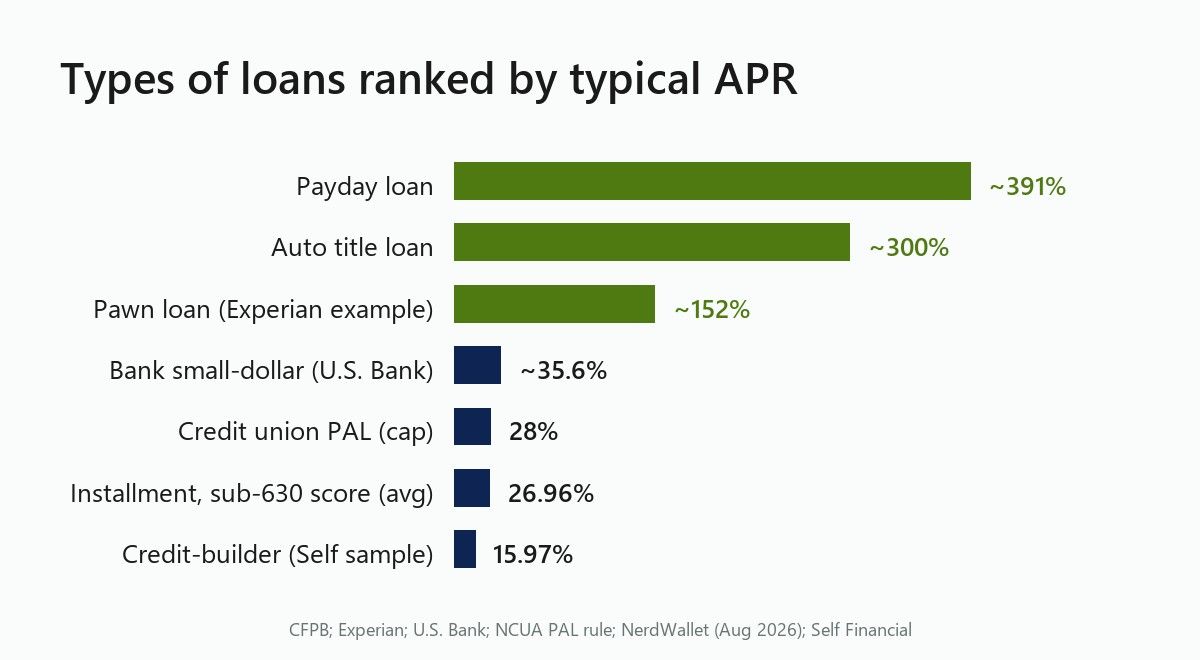
- Credit union PAL: up to 28% APR (federal cap), for credit union members needing $200-$2,000
- Credit-builder loan: about 15.97% APR (already includes a one-time $9 fee), best used to build credit for next time
- Bank small-dollar loan: roughly 35.6% APR equivalent, for existing bank customers
- Personal installment loan: about 15%-27% APR on average by credit tier (NerdWallet), higher for weaker credit
- Credit card cash advance: 3%-5% fee plus interest from day one, for cardholders with open credit
- Earned wage access: a flat fee (roughly $2-$6) or a tip, for hourly or gig workers already owed the money
- BNPL / Pay-in-4: often $0 interest on time, best used for a specific purchase at checkout
- Pawn shop loan: about 152% APR equivalent in a worked example, for borrowers who'd rather skip a credit check entirely
- Payday loan: about 391% APR equivalent, worth trying only after everything above it is ruled out
- Auto title loan: roughly 300% effective APR, best avoided given the repossession risk
Credit Union PAL (Payday Alternative Loan)
A PAL is a small loan offered only by federal credit unions, built specifically to compete with payday lenders on price. You apply, the credit union checks your membership and ability to repay, and you pay it back in fixed installments instead of one lump sum. PAL I loans run $200 to $1,000 over one to six months, and PAL II loans go up to $2,000 over twelve months. Both are capped at 28% APR by federal rule, with an application fee no higher than $20, the one hard federal rate ceiling on this entire list.
For the full eligibility rules and how to apply, read quick5k's credit union PAL deep dive. Best for: anyone who already belongs to a federal credit union, or can join one before payday arrives.
Credit-Builder Loan
This one works backward from every other loan on this list, and it's the one exception on this page: it doesn't put cash in your hands today. The lender locks your loan amount in a savings account, you make monthly payments toward it, and the money releases to you once you've paid it off. Your payments get reported to the credit bureaus the whole time.
Self Financial's published sample shows $35 a month for 24 months ($840 total paid in) at 14.70%-15.69% interest, 15.97% APR with a one-time $9 fee, according to Self Financial's own credit-builder loan explainer. You get back roughly $717 to $724 once you finish, since the lender keeps the rest as interest. It builds your score for the next emergency, not this one. Best for: someone whose car repair is already covered another way and wants a cheap, structured way to build credit history.
Bank Small-Dollar Loan
A handful of major banks now offer small, fast installment loans to existing customers. U.S. Bank's Simple Loan charges $6 per $100 borrowed, which works out to roughly 35.6% APR, per U.S. Bank's own fee disclosure.
Terms and pricing vary by bank, so check your bank's app before assuming this exact number applies to you. Best for: someone who already banks somewhere with this kind of program and wants a small loan without leaving their existing banking relationship.
Personal Installment Loan
A traditional personal loan from a bank, credit union, or online lender, repaid over months or years in fixed monthly installments. Pricing depends heavily on your credit score. NerdWallet's August 2026 data puts the average at 26.96% APR for borrowers with sub-630 credit scores versus 14.70% for scores 720 and above.
OneMain Financial's own disclosed fee range is 11.99% to 35.99% APR. Best for: a borrower who wants a fixed payment and a set payoff date, with a little more time than a same-day emergency allows for approval and funding.
Credit Card Cash Advance
If you already have a credit card, you can typically withdraw cash against your limit at an ATM or bank teller. The catch is the pricing: card issuers charge a fee that's the greater of a flat dollar amount or 3% to 5% of the advance, and interest starts accruing immediately with no grace period, unlike a normal purchase, per Bankrate's reporting on issuer terms.
Federal Regulation Z (12 CFR 1026.53) requires issuers to apply any payment above your minimum to your highest-APR balance first, which is usually the cash advance. Best for: someone with available credit limit and a gap they can close within a billing cycle or two.
Earned Wage Access (EWA)
EWA apps let you access wages you've already earned but haven't been paid yet, ahead of your normal payday. Because the CFPB's December 2025 advisory opinion determined that qualifying EWA doesn't count as "credit" under federal lending law, providers charge flat or tip-based fees instead of an APR.
Representative instant-transfer fees include DailyPay's $3.49 flat fee, Payactiv's $1.99 expedited fee (free with a qualifying direct deposit), and EarnIn's $3.99-$5.99 tiered fee, each per that provider's published fee page. For the full state-by-state legal picture and provider comparison, read quick5k's EWA state rules guide. If you're weighing EWA against just overdrafting your checking account instead, quick5k's cash advance apps vs. overdraft fees comparison walks through that math.
Best for: hourly or gig workers who need a bridge of a few days, not a few weeks, borrowing only against money already earned.
BNPL / Pay-in-4
Buy now, pay later splits a specific purchase into four payments right at checkout. The CFPB's consumer page confirms that many BNPL loans charge no interest at all when you pay on schedule, though most do charge a late fee if you miss a payment, per the CFPB's BNPL fee explainer.
Exact late-fee dollar amounts vary by provider, so check quick5k's BNPL / Pay-in-4 guide for a provider-by-provider breakdown. Best for: a specific purchase you'd otherwise pay for in full.
Pawn Shop Loan
You hand over something of value, an item like jewelry or electronics, and the shop lends you a percentage of its resale value, typically 25% to 60%, holding the item as collateral for 30 to 90 days. No credit check happens because your item is the entire approval process.
Experian notes that pawn loan rates can range anywhere from about 12% to 240% APR or more depending on the state, and gives a concrete example: a $200 pawn loan with a $25 fee over 30 days works out to roughly 152% APR, per Experian's pawn loan explainer. Compare that against an online installment lender in quick5k's pawn vs. online installment comparison. Best for: someone who wants zero credit impact and is comfortable losing the item if they can't repay.
Payday Loan
A payday loan is a short-term, single-payment loan, usually due in full on your next payday, typically two weeks out. The standard fee structure is about $15 per $100 borrowed, which the CFPB calculates works out to roughly 391% APR on a two-week term.
The CFPB's 2013 study found the average payday loan ran around $375, with the median borrower taking out eight loans a year, a pattern that turns a one-time gap into a recurring cost. For the full math on how that fee translates into an annual rate, see quick5k's true-cost APR article. Best for: almost nobody, once you've looked at every option above it; treat it as a true last resort.
Auto Title Loan
A title loan uses your vehicle's title as collateral, letting you borrow against a car you typically still get to drive while repaying. The CFPB reports a typical loan amount around $700 with an effective APR near 300%, and finds that roughly one in five title loan borrowers ends up having their vehicle seized for failing to repay.
For everything that can go wrong and safer alternatives to try first, read quick5k's title loan alternatives guide. Best for: the one product on this list worth steering away from entirely if any other option is on the table, since the collateral is your ability to get to work.
How to Pick, Without Overthinking It
Comparing all these types of short-term loans side by side is a lot to hold in your head at 9 p.m. with a bill due Friday and somewhere between $500 and $2,000 on the line. Run through these four questions in order, and you'll land on the right one faster than you'd expect.
How urgent is this, really? If you have a few days to work with, a credit union PAL or personal installment loan gets you a much better rate for a small wait than options built for same-day speed.
Do you belong to a credit union? If yes, check their PAL program before anything else on this list. Its 28% rate is a hard federal ceiling: no PAL can charge more, even if it isn't always the single cheapest number on this page.
What does your credit score allow? A strong score unlocks the cheapest personal installment loans. A thin or damaged file points you toward options where approval doesn't hinge as heavily on your credit history.
How long do you actually need to repay? A repayment window that matches your next paycheck, not your next three, keeps a small-dollar loan from turning into a longer-term debt. This is where payday loans do the most damage: the full balance lands on one payday, all at once.
None of these four questions requires a finance degree. They just require asking them before you sign anything, which is the one step the fine print counts on you skipping.
Frequently Asked Questions
What are the main types of loans for a small emergency?
For a $500-$2,000 emergency, your realistic options are a credit union PAL, bank small-dollar loan, personal installment loan, cash advance, EWA, BNPL, pawn, payday, or title loan. PAL's 28% federal cap is the strongest legal rate protection here, though credit-builder and top-tier personal loans can price lower. Payday loans sit at the expensive extreme, around 391% APR-equivalent.
What's the cheapest type of loan for bad credit?
A credit union PAL carries the strongest rate protection for a borrower with fair or bad credit, since federal rule caps it at 28% APR regardless of credit history, though it isn't necessarily the single cheapest price available. Bank small-dollar loans and some personal installment lenders that specialize in fair-credit borrowers can also come in well below payday or title loan pricing.
Is earned wage access considered a loan?
Not under current federal rules. The CFPB's December 2025 advisory opinion determined that qualifying earned wage access products aren't "credit" under federal lending law, which is why they carry flat or tip-based fees instead of a disclosed APR. That's also why EWA providers post fees like DailyPay's $3.49 flat charge instead of an interest rate on their pricing pages.
Does BNPL charge interest?
Often not, if you pay on schedule. The CFPB confirms many BNPL loans carry no interest for on-time payers, though most charge a late fee if you miss one. The exact fee amount depends on the provider, so check the terms at checkout before you split a purchase into four payments.
Why are payday and title loans so much more expensive than the rest?
Both carry no federal interest rate cap, so pricing is set entirely by state law and by the lender, with nothing like the 28% PAL cap to hold it down. A payday loan's typical $15-per-$100 fee on a two-week term works out to about 391% APR, and a title loan's typical terms work out to an effective APR near 300%, according to CFPB data.
Can I get a small emergency loan with no credit check?
Yes. Pawn shop loans use your item as collateral instead of a credit check, so the shop lends against resale value rather than your credit file, and keeps the item if you don't repay within the 30-to-90-day window. For a fuller breakdown of what "no credit check" actually means across other loan types, read quick5k's no-credit-check-loan guide.