


Navy Federal personal loan rates run from 8.74% to 18.00% APR on loans up to 36 months, according to the credit union's own rate table, dated September 25, 2026. Stretch the term to 37 to 60 months and the floor rises to 10.69%, but the ceiling holds at exactly 18.00% APR no matter how long you borrow. That ceiling shows up on every tier of Navy Federal's rate table. It's a federal regulatory limit set by the credit union's own regulator, and once you see where it comes from, the rest of the pricing makes sense.
This matters most if you belong to the credit union, or qualify through a family member's service, and you're weighing a small loan, say $500 to $1,500, against a payday loan or a cash advance app to cover a bill before your next paycheck.
You either already bank with Navy Federal and want to know what you'll actually pay before you apply, or you just found out you qualify through a spouse, parent, or your own service record and you're sizing up whether it beats the payday shop down the street. Both readers need the same thing: the current published numbers straight from the source, since a rate quoted by a third-party review site can run months stale.
Current Navy Federal Personal Loan APR by Term
Navy Federal calls its standard small-dollar product a Personal Expense Loan, and the rate you're quoted depends heavily on your credit profile and the length of the loan. As of the credit union's own published table:
- Up to 36 months: 8.74% to 18.00% APR
- 37 to 60 months: 10.69% to 18.00% APR
- 61 to 180 months, for home improvement or other extended-term loans only: 13.29% to 18.00% APR
Notice the pattern. Every floor climbs with the term length, but every ceiling stops at 18.00%. That third tier, 61 to 180 months, is built for larger home-improvement borrowing, not the $500 to $1,500 range most readers land on this page for.
Navy Federal's standard personal loan can go as high as $150,000, but that figure belongs to large home-improvement and extended-term borrowing, and amounts over $50,000 require a qualifying co-applicant, according to Navy Federal's personal loan FAQ page. It has nothing to do with what a small loan actually costs you, which is the question this article answers. Where you land within any of the three ranges above depends on your creditworthiness at the time you apply. Navy Federal states plainly that rates are subject to change and based on creditworthiness, so two applicants borrowing the same amount over the same term can walk away with different APRs.
Term length is a real lever, and it changes what you'll actually pay. A shorter term means a higher monthly payment but less total interest, since you're carrying the balance for less time even at a comparable rate. A longer term lowers the monthly payment but stretches out how long interest accrues.
A loan in the $500 to $1,500 range fits comfortably inside the up-to-36-month tier, which also carries the lowest published floor of the three: 8.74% at the low end versus 10.69% for the 37-to-60-month tier and 13.29% for the 61-to-180-month tier. All three tiers still share the same 18.00% ceiling, so the term you choose mainly changes the floor you might qualify for.
Loan Minimums, Fees, and How Fast the Money Shows Up
The floor on the other end matters just as much as the ceiling. Navy Federal's personal loan minimum is $250, according to the same FAQ page, and that number matters if your need is genuinely small. A $250 loan at the smallest end of Navy Federal's range still caps at 18% APR by law, so even a modest emergency loan carries the same rate ceiling as a much larger one. There's no separate, worse pricing tier reserved for small-dollar borrowers here the way there sometimes is with payday-style products.
Two costs that often sneak into small-dollar lending are absent here. Navy Federal does not charge a personal loan application fee, and paying the loan off early carries no penalty. Both facts matter more than they sound. A payday lender's cost structure is baked into the fee the moment you sign; a Navy Federal loan's cost shrinks the faster you pay it down, and nothing punishes you for doing that.
Funding typically lands the same day once you're approved, per that FAQ page. That speed is one reason this comparison against payday lending is fair: both products can put cash in your account quickly. The difference shows up in what you owe afterward, which the cost comparison further down spells out in dollars.
Who Actually Qualifies for a Navy Federal Loan
None of the rates above apply to you unless you can join Navy Federal, and membership is not open to the general public. Eligibility runs through military service, a Department of Defense connection, or a qualifying family relationship, per Navy Federal's membership eligibility page. You qualify if you fall into one of these groups:
- Active-duty members of the Army, Marine Corps, Navy, Air Force, Coast Guard, National Guard, or Space Force
- Delayed Entry Program participants, DoD Reservists, and ROTC or Officer Candidates
- Veterans, retirees, and annuitants
- Department of Defense civilian employees, DoD contractors assigned to a DoD installation, and DoD civilian retirees or annuitants
- Immediate family members (parents, grandparents, spouses, siblings, children including adopted and step-children, and grandchildren) and household members of anyone in the groups above, or of an existing Navy Federal member
Membership itself requires opening and maintaining a savings account with a $5 minimum balance, per the same eligibility page. That's a small hurdle if you already qualify, but it's a real one to check before you assume you can walk in and borrow. If you don't fit any of the categories above, skip ahead to the section on where else to look.
Why the Rate Tops Out at 18%
Federal credit unions operate under a statutory rate cap of 15% APR, set by the Federal Credit Union Act. But the National Credit Union Administration's Board has the authority to temporarily raise that ceiling when it finds money-market rates have climbed high enough to threaten credit union safety and soundness at the lower cap. The Board's current temporary ceiling is 18%, extended through September 10, 2027, after the prior authorization expired on March 10, 2026, per NCUA's letter extending the loan interest rate ceiling.
That's why Navy Federal's rate table, at every term length, tops out at exactly 18.00% and never a fraction higher. The credit union is pricing right up against the legal limit set by its regulator. Every other federal credit union in the country operates under that same 18% cap, so a Navy Federal member comparing rates elsewhere in the federal credit union system will keep running into that same regulatory ceiling. The authorization expires September 10, 2027 unless the NCUA Board extends it, which is why that date is worth remembering if you're reading this article well after publication.
If you're active-duty or a covered dependent, a separate cap also applies to many consumer credit products. The Military Lending Act limits the Military Annual Percentage Rate to 36% on many loan products, and because the NCUA's 18% ceiling on Navy Federal's loans already sits well under 36%, the NCUA's ceiling is the one actually doing the work on a Navy Federal personal loan. For the mechanics of what the MLA covers and how MAPR is calculated, see this site's breakdown of the 36% cap. It's worth understanding both rules exist, even when only one of them is the binding constraint on the specific loan you're applying for.
$500 Two Ways: Navy Federal Loan vs. Payday Loan
APR comparisons are abstract. Dollars are not. Here's what a $500 loan actually costs under each option, using a representative rate for illustration since your own quoted rate depends on your credit profile.
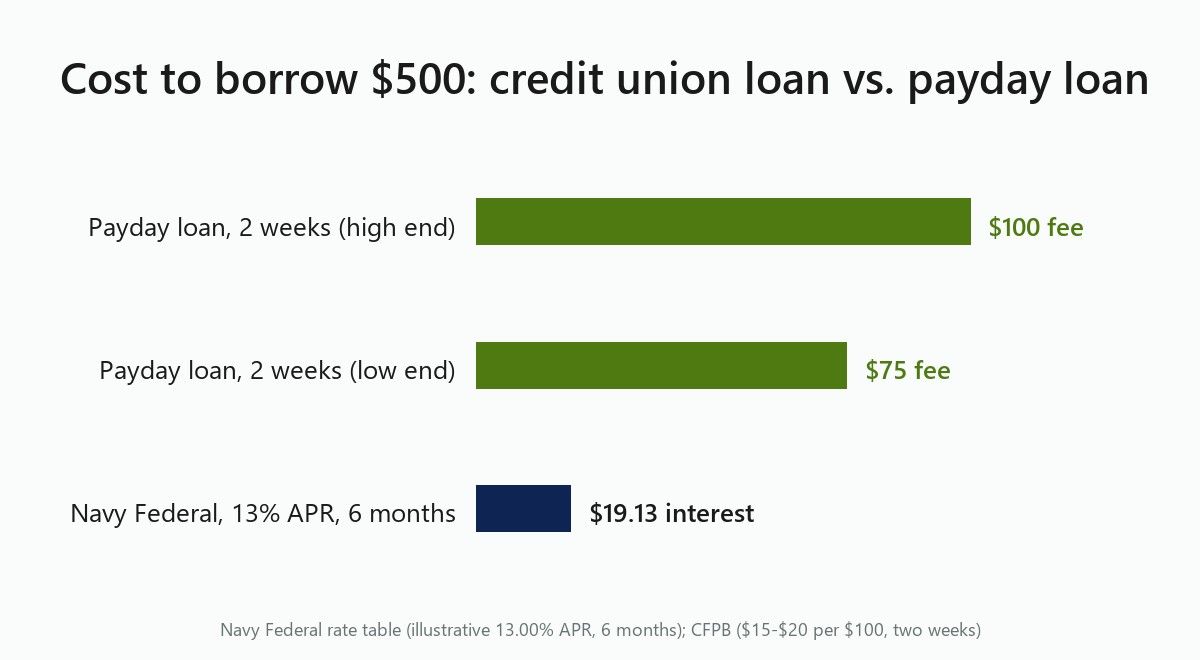
A $500 Navy Federal loan at 13.00% APR, a representative rate near the middle of the verified 8.74% to 18.00% range for terms up to 36 months, repaid over 6 months works out to a monthly payment of about $86.52. Total repayment comes to roughly $519.13, meaning total interest of about $19.13 over the life of the loan. This is an illustrative example, not a quoted or guaranteed rate; your actual rate depends on your creditworthiness, per Navy Federal's rate table.
A $500 payday loan for a single two-week term, at the CFPB's cited range of $15 to $20 per $100 borrowed, costs a $75 to $100 fee. Total repayment lands between $575 and $600, due in full two weeks after you borrow. If you can't repay the full amount on time and the loan renews, that fee applies again each time the loan renews. Pew Charitable Trusts research finds payday loans cost roughly four times more in states with weak consumer protections than in states with strong ones, so the exact fee you'd face depends heavily on where you live.
Lay the two side by side and the choice most borrowers are actually weighing comes into focus. A small monthly payment spread across half a year sits on one side; a single lump repayment due two weeks from now, with a fee that repeats each time the loan renews, sits on the other. For a Navy Federal-eligible borrower with a $500 need, the credit union loan costs roughly $19.13 in interest over six months at the representative rate above. The payday loan costs $75 to $100 for two weeks, before any renewal.
The gap widens the moment a payday loan can't be repaid on schedule. A borrower who needs a second two-week cycle to pay it off owes the $75 to $100 fee again, since the fee resets each time the loan renews. A Navy Federal installment balance works differently: it shrinks with every scheduled payment, and the interest owed shrinks along with it. That structural difference is the real reason total dollars paid diverge so sharply between the two products, even when both can put cash in your account the same day.
If You Don't Qualify
Not every reader comparing loan rates against payday lending has a path into Navy Federal, and that's worth addressing directly. Some readers will check the eligibility list above and realize none of those categories apply to them or anyone in their household, and that's a normal outcome given how specific the membership rules are.
If you don't fit the military, DoD, or family eligibility categories above, this site's roundup of military-friendly lenders and relief societies covers other options built for similar borrowers. And if you're not military-connected at all but want a credit-union alternative to payday lending, a federal credit union Payday Alternative Loan is worth reading about. It's capped well below payday pricing, at 28% APR under NCUA's rule for that product. The eligibility gate is the first thing to check, before the rate table, because the best rate in the world doesn't help if you can't open the account it's attached to.
If you can confirm eligibility through the list above, the next step is straightforward: check the rate table at the top of this article against your own credit profile before you apply anywhere else.
Frequently Asked Questions
The lowest published rate is 8.74% APR, available on loans of up to 36 months to the most creditworthy applicants, per Navy Federal's rate table. Your actual rate depends on your creditworthiness and the loan term you choose, so the 8.74% floor isn't guaranteed to every borrower who applies.
Navy Federal's minimum personal loan amount is $250. That minimum still carries the same 8.74% to 18.00% APR range as larger loans, so a small borrowing need doesn't automatically mean a worse rate. There's also no application fee and no penalty for paying the loan off early, which keeps a $250 loan's true cost close to the interest alone.
Yes, if an immediate family member or household member qualifies through military service, DoD employment, or existing Navy Federal membership. Eligible relatives include parents, grandparents, spouses, siblings, children, and grandchildren. In every case, membership still requires opening and maintaining a savings account with a $5 minimum balance.
Federal credit unions are statutorily limited to 15% APR under the Federal Credit Union Act, but the NCUA Board can temporarily raise that ceiling when market conditions warrant it. The current temporary ceiling is 18%, running through September 10, 2027, per the NCUA letter.
No. Navy Federal doesn't charge a personal loan application fee, and there's no penalty for paying a loan off ahead of schedule. Paying faster than scheduled simply reduces the total interest you owe over the life of the loan.