


You open your mailbox in late January and there it is: a tax form with your name on it and a dollar figure you never saw land in your bank account. It's a Form 1099-C, tied to that personal or installment loan you settled last year. Your first thought is probably something like, "I never got this money as cash, so how can the IRS want tax on it?" That's the real question underneath asking whether personal loans are taxable, and it deserves a straight answer.
So let's answer it plainly: no, taking out a personal loan does not create taxable income. The money you borrow isn't income, because you owe it back. But once a lender agrees to cancel, forgive, or settle part of that debt for less than you owe, the picture changes, and that shift is where the rest of this article lives, from the 1099-C itself to the insolvency exclusion that can wipe out the tax bill entirely.
Are Loans Considered Income? The Short Answer
Here's the underlying logic, and it's simpler than it looks. Income, in tax terms, is money that increases your wealth with no obligation attached. A paycheck qualifies. A loan doesn't, because you're contractually on the hook to pay it back.
IRS Topic 431 treats the cancellation of a debt as the taxable event, which is why taking out a loan doesn't create taxable income on its own. That repayment obligation is what kept the original loan out of your income, and once the obligation disappears, so does the reason for the exclusion.
So the honest answer to whether loans are taxed as income has two parts. The loan itself, at the moment you receive the funds, is never income. The debt, if it's later canceled, forgiven, or settled for less than the full balance, can become income in the year that cancellation happens. That second part is where this article spends most of its time, because it's the part that actually catches people off guard.
The Exception: When Forgiven or Settled Debt Becomes Income
Tax professionals call this cancellation of debt income, usually shortened to COD income. IRS Topic 431 states the rule directly: "In general, if your debt is canceled, forgiven, or discharged for less than the amount owed, the amount of the canceled debt is taxable."
Picture it this way. You owe a lender $3,000. The lender agrees to accept $1,800 and close the account. That remaining $1,200 didn't just vanish.
In the IRS's eyes, you received an economic benefit equal to the amount you no longer have to pay, and that benefit gets treated as ordinary income, reported on Schedule 1 of your return and taxed at your regular income tax rate.
No cash changed hands at settlement, but the tax code doesn't require cash to change hands for something to count as income. It only requires that your financial position improved, and a canceled debt improves your position by the amount you no longer owe. This is also the point where it makes sense to think about timing. If you're still deciding whether to keep paying down a balance or push for a settlement, take a look at how to prioritize which debts to pay first, since a settlement carries this tax consequence and a full payoff doesn't.
The 1099-C: What It Is and What It Isn't
Form 1099-C is the form a lender sends when it cancels a debt. There's a specific dollar threshold that triggers the requirement, per the IRS's About Form 1099-C page: "File Form 1099-C for each debtor for whom you canceled $600 or more of a debt." If your settled or forgiven amount hits $600 or more, expect the form. It gets sent to you and filed with the IRS, so the agency already knows about it before you file your return.
Now for the myth that trips up a lot of people. Some borrowers assume that if a lender never sends a 1099-C, the canceled debt must be tax-free. That's not accurate. The $600 figure is a reporting threshold that tells lenders when they're required to file paperwork, not a floor below which forgiven debt stops being taxable.
If you settle a $400 balance for $100, that $300 difference can still be reportable income on your return, even though no 1099-C ever shows up in your mailbox. If you know debt was forgiven, the responsibility to report it sits with you regardless of whether paperwork arrived. If your loan is already past due and heading toward settlement, here's what the missed-payment timeline looks like.
Ways Out: The Insolvency Exclusion and Form 982
Getting a 1099-C doesn't automatically mean you owe tax on the full amount. The IRS gives you a legitimate way to reduce or eliminate that income, called the insolvency exclusion, and it's the single most useful tool in this whole topic.
Here's the test, straight from IRS Publication 4681: "You were insolvent immediately before the cancellation to the extent that the total of all your liabilities was more than the FMV [fair market value] of all of your assets immediately before the cancellation."
In plain terms, add up everything you owed right before the debt was canceled: credit cards, auto loans, the loan being settled, any other unsecured debt. Compare that total to the fair market value of everything you owned at that same moment: bank balances, a car's resale value, personal property. Future paychecks don't count. If your liabilities were higher than your assets, the gap between those two numbers is your insolvency amount, and you can exclude canceled debt up to that amount from your taxable income.
There's a separate exclusion for debt canceled through bankruptcy: debt discharged in a title 11 bankruptcy case is not included in your income, per the same IRS guidance. Both exclusions share the same filing mechanism. You claim either one using Form 982, which the IRS describes this way: "Form 982 is used to determine, under certain circumstances described in section 108, the amount of discharged indebtedness that can be excluded from gross income." Claiming the exclusion also means reducing certain tax attributes, like net operating losses, credits, or the basis of your property, by the amount you excluded, which is one more reason this form is worth reviewing with a preparer rather than filing on your own.
Neither exclusion applies on its own. You have to calculate your insolvency, attach Form 982 to your return, and claim it. If the 1099-C shows up and you don't address it, the full amount stays taxable income.
The Worked Example: A $3,000 Loan Settled for $1,800
Let's walk through the whole scenario with real numbers, the same way IRS Publication 4681 structures its own examples, so you can see how the pieces connect.
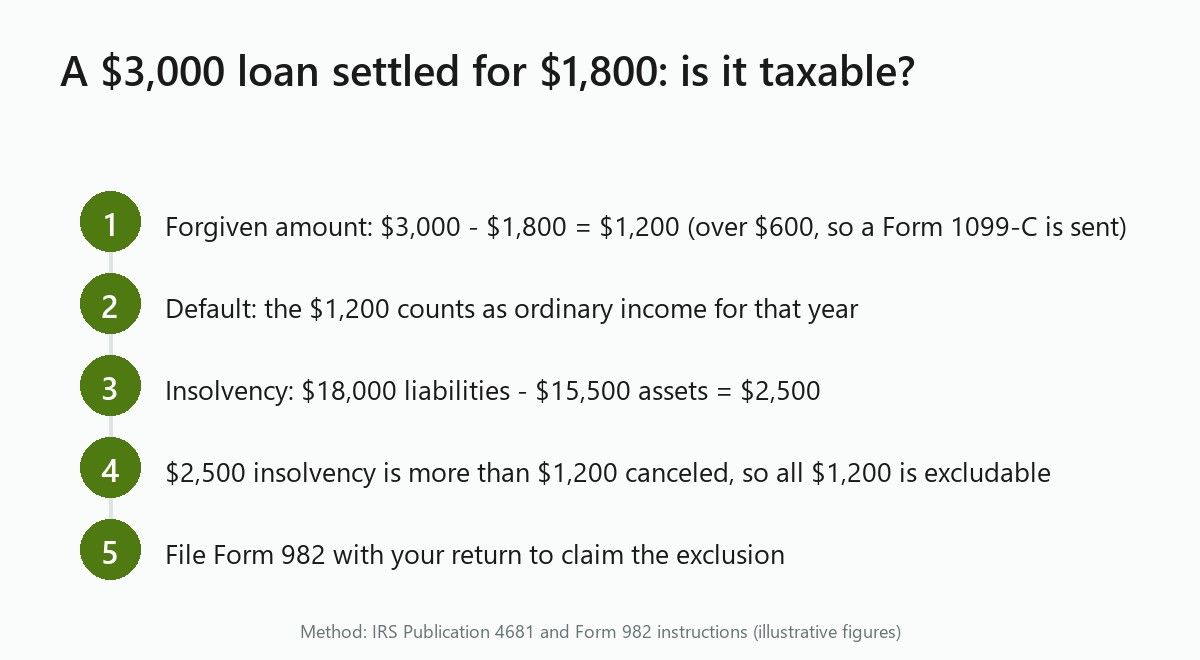
Step 1: Calculate the forgiven amount
You owed $3,000 on a personal or installment loan. The lender agreed to settle for $1,800. The forgiven amount is $3,000 minus $1,800, which equals $1,200. Because that's above the $600 reporting threshold, the lender is required to send you a Form 1099-C listing $1,200 as canceled debt.
Step 2: Understand the default position
Without any exclusion, that $1,200 is treated as ordinary income for the year the cancellation happened. It gets reported on Schedule 1 and taxed at your normal income tax rate, right alongside your wages or self-employment earnings.
Step 3: Run the insolvency test
Now list your financial picture immediately before the cancellation. Say your total liabilities, every debt you owed, including this loan before it was settled, added up to $18,000. Your total assets, bank balances, the value of your car, personal property, added up to $15,500.
Subtract assets from liabilities: $18,000 minus $15,500 equals $2,500. That's your insolvency amount.
Step 4: Compare insolvency to the canceled amount
Your insolvency amount is $2,500. The canceled debt is $1,200. Since $2,500 is greater than $1,200, you were insolvent by more than enough to cover the entire canceled amount. The full $1,200 can be excluded from your taxable income, as long as you file Form 982 to claim it.
Not every situation lines up this cleanly, so here's what changes the outcome. If your insolvency amount had come in lower than the canceled debt, say $1,000 of insolvency against $1,200 of forgiven debt, only $1,000 would be excludable and the remaining $200 would still be taxable. If your assets had exceeded your liabilities right before the cancellation, you wouldn't qualify as insolvent at all, and the full $1,200 would be taxable unless the debt was discharged through bankruptcy instead. The math changes based on your own numbers, but the process stays the same: liabilities minus assets, compared against the canceled amount, claimed on Form 982.
If you're trying to avoid this scenario going forward, a debt consolidation loan works differently at tax time. Those funds are loan proceeds you're obligated to repay, not forgiven debt, so they don't trigger COD income the way a settlement does. Run the numbers on whether consolidating makes sense for your situation before a balance ever reaches settlement.
What About the Interest You Already Paid?
Separate from the settlement question, a lot of borrowers assume interest paid on a personal loan can be deducted the way mortgage interest can. It generally can't. Under 26 U.S.C. § 163(h), personal interest is disallowed as a deduction for individual taxpayers, with narrow, specifically named exceptions: qualified residence (mortgage) interest and certain qualified student loan interest under a separate section of the code.
Interest on a personal loan used to cover rent, medical bills, a car repair, or a settlement itself falls into the same non-deductible category as credit card interest. There's no broader carve-out for personal loans as a category, so don't count on recovering any of that interest at tax time.
What to Do Next
If a 1099-C landed in your mailbox this year, here's the order of operations that keeps you from scrambling in April.
- Locate the 1099-C and confirm the amount listed matches what you understood was forgiven.
- List your total liabilities and the fair market value of your total assets as of the moment right before the cancellation, and calculate your insolvency amount.
- Compare your insolvency amount to the canceled debt figure on the form, to see whether you qualify for a full or partial exclusion.
- Talk to a tax preparer about filing Form 982 if you qualify for the insolvency or bankruptcy exclusion, since it has to be actively claimed.
- If you're currently behind on a loan and worried about where this is headed, look into forbearance before you miss a payment, since it's often the step that prevents a settlement from becoming necessary at all.
If a debt collector is the one contacting you about a settlement and the calls feel relentless, you have rights around how and when they can reach you. Knowing what collectors can and can't do puts you in a stronger position when you're negotiating the settlement terms that will eventually determine your 1099-C amount.
One more thing worth saying directly: this article covers the general federal rules as the IRS states them, meant to help you understand what a 1099-C means and what your options are. It is general information, not personalized tax advice. Your specific numbers, filing status, and state tax rules can change the outcome, so a qualified tax preparer or CPA should review your actual situation before you file.
Frequently Asked Questions
No. Loan proceeds are not income because you're obligated to repay them under the terms of the loan agreement. Tax only becomes a factor if part of that debt is later forgiven, canceled, or settled for less than the full amount you originally owed.
Not receiving a 1099-C doesn't mean the forgiven amount is tax-free. The $600 figure is only the reporting threshold that tells lenders when to file paperwork, so smaller canceled amounts can still count as reportable income even without a form.
Add up your total liabilities and the fair market value of your total assets as of right before the debt was canceled. If liabilities exceeded assets, the difference is your insolvency amount, and you can exclude canceled debt up to that amount by filing Form 982.
Generally no. Personal interest is disallowed as a deduction under 26 U.S.C. § 163(h), with narrow exceptions for mortgage interest and qualified student loan interest. Interest on a personal loan doesn't fall under either exception, whether that loan covered rent, medical bills, a car repair, or the settlement itself, so don't plan on recovering any of it come tax time.
Yes. The exclusion has to be affirmatively claimed on Form 982; it isn't automatic just because you were insolvent. If you receive a 1099-C and don't file the form, the full canceled amount counts as taxable income.